
Why Your Business Needs to Think Like Your Customers
If you've ever wondered why your perfectly optimized website isn't getting the traffic or recommendations you expected, the answer might surprise you: AI assistants search differently than humans do, and they're rapidly becoming the primary way your customers find local businesses.

When someone asks ChatGPT, Claude, Perplexity, or Gemini for help finding a service provider, these AI systems don't just look at your keywords. They execute hidden searches your customers never see, looking for specific signals that prove you can solve their exact problem. If your content isn't aligned with how AI actually searches, you're missing a rapidly growing channel for customer discovery—even if your traditional SEO is solid.
The Shift from Keywords to Conversations
Let's look at a real example. Imagine someone's air conditioner breaks down during a summer heat wave in Madison, NH. Here's how they might search:
Traditional Google Search (Old Way):
"emergency AC repair Madison NH"
"AC repair near me"
"Madison HVAC services"
AI Assistant Query (New Way):
"My air conditioner stopped working during a heat wave and I need someone today near Madison NH"
See the difference? The AI query is conversational, includes context (heat wave), expresses urgency (today), describes the problem (stopped working), and specifies location (Madison NH). This isn't just a different writing style—it's a fundamentally different way of searching that requires a different approach to content.
What Happens Behind the Scenes When Someone Asks AI for Help
When a customer asks an AI assistant for a recommendation, that AI doesn't simply search for the words they typed. Instead, it breaks down their request and executes multiple targeted searches to find the most relevant, trustworthy answer.
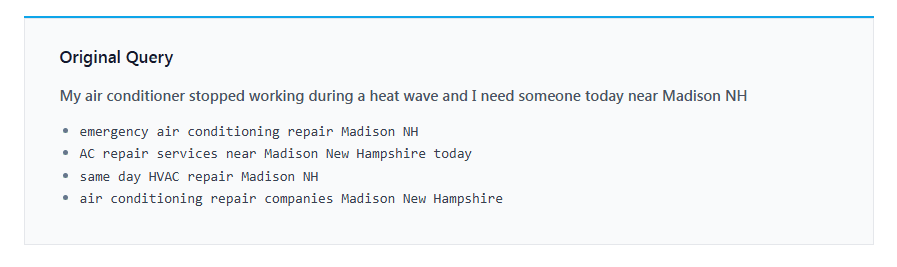
Using our HVAC example, when someone says "My air conditioner stopped working during a heat wave and I need someone today near Madison NH," the AI might execute searches like:
"emergency air conditioning repair Madison NH"
"AC repair services near Madison New Hampshire today"
"same day HVAC repair Madison NH"
"air conditioning repair companies Madison New Hampshire"
These hidden queries are what AI systems use to evaluate which businesses can actually help. If your website content doesn't address these specific queries and related concerns, the AI simply won't find you—even if you're the best HVAC company in Madison.
This is exactly what a Content Strategy Report reveals: the actual queries AI systems execute when customers ask for help in your industry. You can see these queries listed in the "Why This Matters" section at the top of every report.
The Three Types of Intent AI Looks For
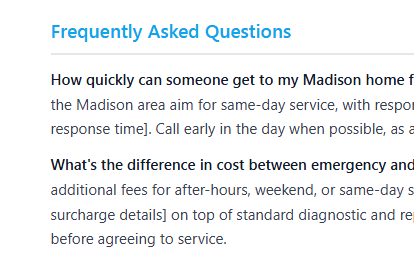
AI systems evaluate content based on three types of user intent, and your website needs to address all three to be considered a complete, authoritative source. This is exactly why every Content Strategy Report includes a comprehensive FAQ section—it's specifically designed to cover all three intent types that AI systems look for.
1. Transactional Intent ("I want to hire someone") These are the money questions: pricing, service areas, availability, emergency fees. Look at the FAQ section in the HVAC report example—you'll see questions like "What's the difference in cost between emergency and regular AC service?" This directly answers a transactional question that could make or break whether someone calls you.
2. Informational Intent ("I need to understand this") These queries help customers make informed decisions. In the report's FAQ section, questions like "What qualifies as an emergency AC repair?" and "Should I try to fix my AC myself while waiting for the technician?" provide the educational content that positions you as an expert, not just a vendor.
3. Navigational Intent ("Where can I find this service?") Location-specific queries help customers find and verify you. The FAQ addresses this with questions like "How quickly can someone get to my Madison home for emergency AC repair?"—combining location context with practical information.
When AI systems evaluate your website, they're checking whether you comprehensively cover all three intent types. Missing any category signals that your site is incomplete compared to competitors who provide a more helpful, thorough experience. This is why the FAQ section in your Content Strategy Report is so critical—it ensures you're addressing every type of question AI systems are looking for.
Why AI Trusts Structured Answers Over Keyword Stuffing
Here's where many businesses get stuck: they've spent years optimizing for keywords, but AI doesn't work that way.
Look at the FAQ section in the HVAC report example. Each question isn't just answered—it's structured with:
A clear, specific question that matches natural language
A comprehensive answer that actually helps someone
Additional context and guidance
Related information that addresses follow-up concerns
Compare these two approaches:
Keyword-Stuffed Content (Old SEO): "Need emergency AC repair Madison NH? We provide emergency AC repair services in Madison NH with same-day emergency AC repair in Madison NH and surrounding areas."
AI-Optimized Content (New Approach): "Most emergency HVAC services in the Madison area aim for same-day service, with response times typically ranging from 2-4 hours. Call early in the day when possible, as afternoon and evening slots fill up quickly during heat waves."
The second approach answers a real question with specific, helpful information. It uses natural language, provides context, and addresses the underlying concern (urgency and timing). This is what AI systems look for when determining which businesses to recommend.
The Schema Layer: Speaking AI's Native Language
Even if you have great content that answers customer questions, there's one critical piece that makes it readable to AI: schema markup.
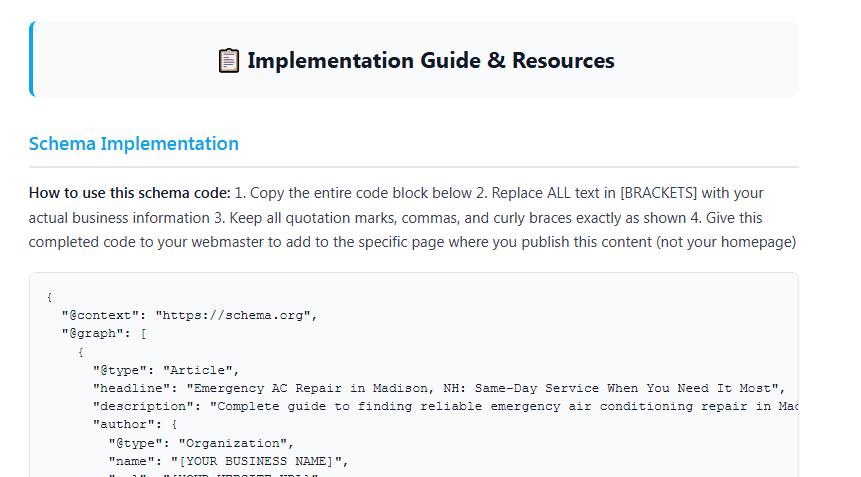
Think of schema as the translation layer between your human-readable content and AI's technical understanding. Every Beacon4ai® Content Strategy Report includes a complete schema code block (you'll find it in the "Schema Implementation" section) that tells AI systems:
What type of content this is (Article, FAQ, Local Business, Service, etc.)
Who wrote it and when
What questions are being answered
How the information is structured and related
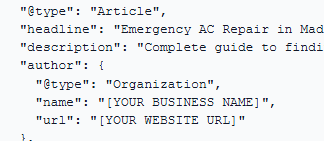
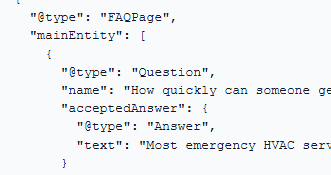
Without schema markup, AI sees your content like a book written in a language it can barely understand. Your website is the foundation of AI visibility… it's where AI learns who you are. With proper schema, you're speaking AI's native language, making it exponentially more likely that AI will understand, trust, and recommend your content.
In the HVAC report example, notice how the schema code includes both Article markup (defining the content) and FAQPage markup (explicitly labeling the questions and answers). This dual-layer approach ensures AI systems can both find and properly categorize your content.
For a complete guide to implementing schema, see our Schema Implementation Guide.
Why Location Context Matters More Than Ever
Notice how the original query included "near Madison NH"? Location context is critical in AI search behavior because AI assistants are trying to provide immediately actionable recommendations.
When AI evaluates HVAC companies for this query, it's looking for:
Explicit mentions of service areas (Madison, NH)
Location-specific advice ("New Hampshire climate considerations")
Regional context (response times "in the Madison area")
Local verification signals (proper licensing "in New Hampshire")
This is why generic, location-neutral content performs poorly with AI systems. The report generated content specifically tailored to Madison, NH because that's what the customer actually needs and what AI is actually searching for.
The Content Gap Most Businesses Don't Know They Have
Here's the uncomfortable truth: most businesses create content about what they want to sell, not what customers are actually asking about.
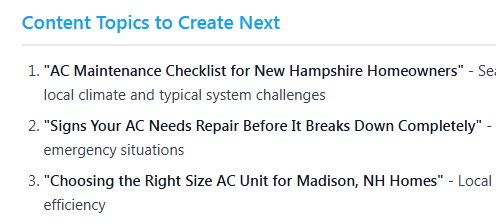
Look at the "Content Topics to Create Next" section in the HVAC report. These aren't randomly suggested topics—they're directly related to the questions and concerns AI systems identify as relevant to the original customer query:
"AC Maintenance Checklist for New Hampshire Homeowners"
"Signs Your AC Needs Repair Before It Breaks Down Completely"
"Heat Pump vs Central Air: What Works Best in New Hampshire"
Each of these topics addresses a related question someone might ask before, during, or after needing emergency AC repair. By creating content around these topics, you're building comprehensive coverage that positions you as the go-to expert in your area.
This is the content gap: you might have a services page that lists "Emergency AC Repair," but do you have content that addresses the real questions customers ask when they're in that emergency situation?
How to Use Customer Language to Inform Your Content Strategy
The most valuable insight from understanding AI search behavior is this: your customers are already telling you exactly what content you need to create.
Pay attention to:
Questions customers ask during initial phone calls
Common concerns mentioned in reviews (yours and competitors')
Follow-up questions after you provide service
Complaints or confusion points in your sales process
Seasonal patterns in service requests
In our HVAC example, the original query revealed multiple content opportunities:
The urgency factor ("I need someone today")
The context (heat wave timing)
The emotional state (implied stress and discomfort)
The location requirement (Madison NH)
Each of these elements represents a question your content should answer:
How quickly can you respond?
What should customers do while waiting?
What qualifies as an emergency?
Do you service Madison specifically?
When you create content that directly addresses these real customer concerns using their actual language, AI systems recognize that your content is genuinely helpful and relevant—not just optimized for search engines.
The Internal Linking Structure AI Expects to Find
Notice the [LINK TO: ...] markers throughout the article in the report? These aren't optional decorations—they're strategic signals that help AI understand the structure and depth of your expertise.

AI systems evaluate how your content connects to other pages on your site. When you link from the emergency AC repair article to:
Your maintenance services page
Your service area information
Your preventive maintenance plans
You're creating a web of related information that proves comprehensive expertise. This internal linking structure helps AI understand:
The scope of your services
The depth of your knowledge
The organization of your content
The relationship between topics
A single well-optimized page is good. A network of interconnected, helpful content is what makes AI systems confident in recommending you over competitors.
Learn more in our complete Internal Linking Strategy guide.
What Makes AI Recommend One Business Over Another
When multiple businesses could potentially help a customer, AI systems use specific signals to determine which one to recommend. Based on our HVAC example, here's what AI is evaluating:
Relevance: Does your content directly address the customer's specific situation? (Emergency, heat wave, Madison NH location)
Completeness: Do you answer the full range of questions someone in this situation would have? (Costs, timing, what to expect, temporary solutions)
Credibility: Do you demonstrate actual expertise and provide specific, actionable information? (Not vague promises, but actual response times and procedures) Reviews are one of the strongest trust signals AI evaluates but only if you build them correctly.
Accessibility: Is your information structured in a way that's easy for AI to parse and understand? (Schema markup, clear FAQs, proper headers)
Transparency: Do you provide upfront information about pricing, processes, and what customers should expect?
The HVAC report example scores well on all these dimensions because it was reverse-engineered from how AI actually evaluates content. It's not optimized for keywords—it's optimized for helpfulness, which is what AI systems prioritize. These align with the 15 AI Visibility Metrics we've identified.
Moving from Traditional SEO to AI Visibility
The shift from traditional SEO to AI visibility doesn't mean abandoning everything you've learned… it means evolving your approach to match how people actually search and how AI systems actually evaluate content.
Traditional SEO focused on:
Keywords and keyword density
Backlinks quantity
Meta descriptions
Page titles
Domain authority
AI Visibility focuses on:
Natural language and conversational content
Comprehensive question coverage
Structured data (schema markup)
Intent matching across all three types
Interconnected content depth
The good news? Content that works well for AI visibility also works well for humans. When you write to genuinely help someone solve their problem, using their language, addressing their concerns, providing specific guidance… you create content that both AI and humans find valuable. This practice is called Answer Engine Optimization - here's our complete guide to getting started.
Your Next Steps: Listening to What Customers Are Actually Asking
Understanding AI search behavior starts with a simple shift in mindset: stop thinking about what you want to rank for, and start paying attention to what your customers are actually asking about.
Every customer interaction is a content opportunity:
The client who wants to know why emergency service costs more
The prospect who's nervous about being overcharged during an emergency
The customer who needs to know what temporary cooling options exist while waiting
These aren't just service calls… they're content topics that, when properly addressed on your website, make you visible to AI systems when similar questions are asked.
A Content Strategy Report shows you exactly what AI systems are searching for when customers ask questions in your industry. It reveals the hidden queries, structures the content to match AI expectations, provides the schema code to make it all readable, and even suggests related topics to build comprehensive coverage.
The businesses that thrive in an AI-powered search environment won't be the ones with the most keywords—they'll be the ones who genuinely understand and address what their customers are actually asking about.
About Beacon4ai® Content Strategy Reports
This article references examples from an actual Content Strategy Report generated for the query "My air conditioner stopped working during a heat wave and I need someone today near Madison NH." These reports show businesses exactly what AI assistants search for when customers ask questions in their industry, providing the content structure, schema code, and strategic guidance needed to become visible in AI-powered search results.