
Written by Debbie Anderson, Founder of Beacon4ai | April 24, 2026
If you run a business in New Hampshire, your Google Business Profile (GBP) is not just a nice-to-have... it is the digital front door that determines whether a potential customer finds you or your competitor. The good news is that most NH businesses are leaving serious ground on the table, and a well-optimized profile can move you into the local 3-pack faster than almost any other marketing investment. Here is exactly how to do it in a way that actually fits the Granite State market.

Why Google Business Profile Matters More in New Hampshire Than You Might Think
New Hampshire is not Boston. It is not a dense metro where thousands of competing businesses are fighting over every keyword. It is a state of small cities, tight-knit towns, and regional communities where a single well-optimized Google Business Profile can make you the obvious choice across a wide geographic area.
Here is the reality of how NH consumers search: someone in Nashua might be searching for a plumber, a restaurant, or a financial advisor within a 20 to 30-mile radius that crosses town lines and sometimes county lines. Google's local algorithm is designed to surface the most relevant and trusted business for that search, and your GBP is the primary signal it uses to make that call.
On top of traditional Google search, AI assistants like ChatGPT, Perplexity, and Gemini are now answering "where should I go" and "who should I call" questions directly. They pull from your GBP data, your website, and your reviews. A complete, active profile feeds all of those systems simultaneously. In 2026, Google's own AI features... including AI Overviews and Gemini-powered Ask Maps... also pull directly from your profile to answer local search questions before a customer ever clicks through to your website.
Step 1: Claim and Verify Your Profile (If You Haven't Already)
Start at business.google.com. Search for your business name to see if a listing already exists... Google sometimes creates unverified listings automatically from public data. If one exists, claim it. If not, create it from scratch.
Verification now includes several options: postcard mailed to your business address, phone, email, or video verification (Google expanded the video option in 2025). Video verification... where you record a short clip showing your business exterior with identifiable landmarks... has become a faster route for many businesses. Do not skip this step. An unverified profile has severely limited visibility and cannot rank in the local pack.
One critical 2026 update worth knowing: Google now enforces stricter business name policies. If your profile name includes keyword descriptors like "best," "#1," or anything beyond your actual business name, Google may suspend your profile. Your business name must match your real-world signage and legal documents exactly.
NH-specific note: If your business operates from a home address (very common in rural New Hampshire), you can hide your address on your public profile and instead set a service area. This is ideal for contractors, mobile service providers, and home-based businesses throughout the state.
Step 2: Nail Your NAP Consistency Across Every Platform
NAP stands for Name, Address, and Phone number. Google cross-references your GBP information against dozens of other sources... your website, Yelp, local directories, NH chamber of commerce listings, and more. Inconsistencies confuse the algorithm and cost you ranking positions.
Here is what "consistent" actually means in practice:
Detail | Right Way | Wrong Way |
|---|---|---|
Business name | Exactly as registered | Adding "LLC" sometimes, skipping it others |
Address | "123 Main Street" | "123 Main St" in some places, "123 Main Street" in others |
Phone number | (603) 555-0100 | 603-555-0100 in one place, 6035550100 in another |
Website URL | https://www.yourdomain.com | Mixing www and non-www versions |
Use your local 603 area code. If you have both a local number and a toll-free number, list the 603 number as your primary. It reinforces your geographic relevance to Google's algorithm and, frankly, it builds more trust with NH consumers who are accustomed to seeing local numbers.
Audit every place your business appears online and standardize the format. Common places to check include your website footer, your Facebook page, any local NH directory listings, and regional chamber of commerce pages.
For a deeper look at why NAP consistency matters specifically for AI search visibility, the AI visibility guide for New Hampshire businesses covers how citation consistency feeds into what ChatGPT and Perplexity recommend.
Step 3: Choose Your Business Category With Precision
Your primary category is one of the strongest ranking signals in your entire GBP. Google uses it to decide which searches your profile is eligible to appear in. In 2026, Google's AI models analyze category context more deeply than in previous years, so an even slightly inaccurate primary category can meaningfully reduce your visibility for high-intent searches.
The most common mistake NH businesses make here is choosing something too broad. "Contractor" instead of "General Contractor." "Restaurant" instead of "Seafood Restaurant" or "Farm-to-Table Restaurant." "Lawyer" instead of "Estate Planning Attorney" or "Personal Injury Attorney."
The more specific your primary category, the less competition you face and the more qualified the searchers you attract.
You can also add secondary categories to capture related searches. A landscaping company might list "Landscaping Company" as primary and add "Snow Removal Service" and "Lawn Care Service" as secondary categories... especially relevant in New Hampshire where seasonal services are a major part of many businesses' revenue.
One 2026 enforcement note: Google now uses AI to detect category misuse. Avoid adding categories that don't genuinely apply to your business... even if a competitor is doing it. The risk of profile suspension is real.
Step 4: Write a Business Description That Works for NH Searches
You have 750 characters for your business description. Use them strategically.
Your description should include:
What you do (specific, not generic)
Where you serve (mention specific NH towns or regions, not just "New Hampshire")
What makes you worth choosing (your real differentiator, not marketing fluff)
Natural keyword placement (your primary service + your location, worked into readable sentences)
Here is the structure to follow:
[PLACEHOLDER: Write 2-3 sentences describing your specific services and what you do best. Then add 1-2 sentences naming the specific NH towns, counties, or regions you serve. Close with 1 sentence about what makes you different... years of experience, a specific specialty, a community connection, or a genuine local credential.]
What to avoid: Do not stuff your description with keywords in a way that reads unnaturally. Google's algorithm... and NH consumers... can both tell when a description sounds like it was written for a robot.
Step 5: Use NH-Specific Keywords in the Right Places
This is where most generic guides fall short. They tell you to "use local keywords" without explaining how local actually works in New Hampshire.
Here is a practical framework for NH keyword placement:
In your business description: Include the name of your town or city, plus any neighboring towns you serve. In a state where towns sit close together, mentioning "serving Concord, Bow, Pembroke, and the Lakes Region" is more useful than just "serving New Hampshire."
In your Google Posts: When you publish posts to your GBP (more on that below), use specific NH place names naturally. "Ready for ski season in the Mount Washington Valley" or "Serving homeowners in the Monadnock Region" signals local relevance to Google.
In your responses to reviews: When you respond to customer reviews, you can naturally work in your location and service type. "Thank you for choosing us for your [service] in [town]" is a simple way to reinforce local relevance.
What about NH landmarks? Mentioning proximity to recognizable NH landmarks can help for certain business types... especially tourism, hospitality, and retail. If you are near a well-known NH destination, your location is a feature worth mentioning naturally.
Step 6: Add Complete Business Information (Every Field Matters)
Google rewards completeness. Every field you leave blank is a signal that your profile is less trustworthy than a competitor who filled everything out. Profiles that are fully filled out appear in search results significantly more often than those with missing information... completeness is no longer optional in a competitive local market.
Work through this checklist:
Hours of operation: Keep these accurate and update them for holidays. NH consumers checking hours before they drive across town will not forgive an outdated listing.
Website URL: Link to your actual homepage or, better yet, a relevant landing page.
Phone number: Confirmed local 603 number.
Products and services: Add individual service or product listings with descriptions. In 2026, Google uses your services content to match long-tail and conversational search queries... so write each service description in plain language that explains what the service includes, who it is for, and what the outcome is. Short titles alone are no longer enough.
Business attributes: These vary by category but can include things like "Veteran-owned," "Women-owned," "Wheelchair accessible," or "Outdoor seating." NH consumers searching for specific attributes will filter by these.
Booking link or appointment URL: If you take appointments, connect your booking system here.
GBP Messaging: Google now monitors response times in the messaging feature and factors it into rankings. If you enable messaging, assign someone to respond within 24 hours or set up auto-responses for after-hours.
A note on holiday hours: New Hampshire has several state-specific holidays and major seasonal events (foliage season, ski season, local festivals) where your hours may change. Keeping special hours updated prevents frustrated customers and shows Google that someone is actively managing this profile.
Step 7: Load Your Profile With Strong Photos and Videos
Profiles with photos receive significantly more clicks and direction requests than those without. This is not an opinion... Google's own data supports it.
Here is a practical photo strategy for NH businesses:
Cover photo: A high-quality image of your business exterior, team, or signature product. Make it look like New Hampshire if you can... seasonal scenery, local character, authentic feel.
Interior photos: Show what customers experience when they arrive.
Team photos: New Hampshire consumers trust people, not logos. Faces matter.
Work samples or product photos: Show the actual quality of what you deliver.
Seasonal photos: Update these through the year. A photo of your business in fall foliage season, in winter, and in summer shows an active, thriving business.
Aim for a minimum of 10 photos to start, and add new ones regularly. Google surfaces recently added photos in some search results, so freshness here works in your favor.
Videos are worth adding too. GBP now supports videos up to 60 seconds, and video content can meaningfully boost engagement on your profile. Keep them authentic... a quick walkthrough of your space, a time-lapse of your work, or a short introduction from your team does more for NH consumers than a polished commercial.
Step 8: Build a Review Strategy That Fits NH Culture
New Hampshire consumers are independent-minded. They research before they buy, they trust peer recommendations, and they are skeptical of anything that feels inauthentic. Your review strategy needs to match that culture.
Ask every happy customer. The simplest review strategy is also the most effective: develop a habit of asking satisfied customers directly, right after the positive experience, to share their feedback on Google. Google formalized review request links and QR codes at the end of 2025. You can now generate a direct link or a printable QR code straight from your GBP dashboard that takes customers right to your review form... make this part of your follow-up routine.
Respond to every review. Every single one... positive and negative. Your responses show potential customers how you operate. A thoughtful response to a negative review can actually build more trust than a string of five-star ratings with no engagement.
What to say in responses: Thank reviewers by name if they used one. Mention the specific service or product they referenced. For negative reviews, acknowledge the concern professionally and offer to resolve it offline. Do not get defensive.
The NH community angle: Many NH towns are small enough that word spreads fast. A business that engages genuinely with reviews builds a reputation that extends well beyond Google.
One important policy note: Google strictly prohibits offering incentives... discounts, freebies, or anything of value... in exchange for reviews. This counts as fake engagement and can result in penalties. Just ask. That is all you need to do.
For the full picture on building reviews the right way — including what Google's policies allow and what they don't — Google Reviews: Your 24/7 Sales Team covers the rules and the strategy in depth.
Step 9: Post Regularly to Your GBP (This Is Where Most NH Businesses Drop the Ball)
Google Posts are short updates that appear directly on your profile. Most NH businesses either never use them or posted a few times years ago and stopped. That is a missed opportunity.
Posts can include:
Offers: A seasonal promotion, a limited-time discount, or a package deal
Updates: New services, new hours, new team members, or a new location
Events: Community events you are hosting or sponsoring (very relevant in NH's community-oriented culture)
Products: Spotlighting a specific product or service with a photo and description
For NH businesses especially, seasonal posts are a natural fit. Here are examples of the kinds of posts that match the NH calendar:
Spring: Home preparation services, landscaping, allergy-season health topics
Summer: Tourism-adjacent services, outdoor products, summer hours
Fall: Heating system prep, harvest-related products, foliage season availability
Winter: Snow removal, holiday hours, cold-weather services, ski-related businesses
Post at least twice per week. Posting frequency became a top-tier local ranking signal in 2026, and businesses posting two or more times per week see meaningfully stronger engagement than those posting monthly or sporadically. The good news: you can now schedule posts in advance directly from your GBP dashboard, which makes staying consistent much easier.
One note on post lifespan: "What's New" posts stay live for 7 days before archiving. Event and Offer posts remain visible through their end date. Scheduling ahead keeps your profile from going quiet between active periods.
Step 10: Optimize for AI Search Discovery (The Edge Most NH Businesses Don't Know About)
This is the part of GBP optimization that no generic guide currently addresses, and it is becoming more important every month.
When someone asks ChatGPT, Perplexity, or Google's Gemini a question like "who is the best [service] near [NH town]," these AI systems pull information from multiple sources simultaneously. Your GBP data, your website content, your reviews, and your mentions across the web all feed into what the AI recommends.
Here is what that means practically for your GBP:
Complete profiles win. AI systems prefer sources with complete, structured information. An empty or half-filled GBP is less likely to be surfaced.
Review content matters. AI systems read and summarize reviews. Reviews that mention your specific services, your location, and your quality in natural language are valuable training data for what the AI will say about your business.
Your Q&A section is underused but powerful. Google's Q&A section is evolving. In late 2025, Google began introducing "Ask Maps," a Gemini-powered feature that generates instant conversational answers based on your profile data, reviews, and website... rather than waiting for a business owner to respond manually. This makes your Q&A content even more important as source material. Populate it with the real questions your customers ask most often and answer them clearly and specifically. The AI is reading your answers.
Consistency across the web: AI systems cross-reference multiple sources. If your business name, address, and key services appear consistently across your website, your GBP, your LinkedIn page, and any NH directory listings, you become a more reliable source for AI recommendations.
If you want to go deeper on how small businesses get discovered by AI search engines… beyond just GBP — How Small Businesses Get Found by AI Search Engines lays out the full foundation.
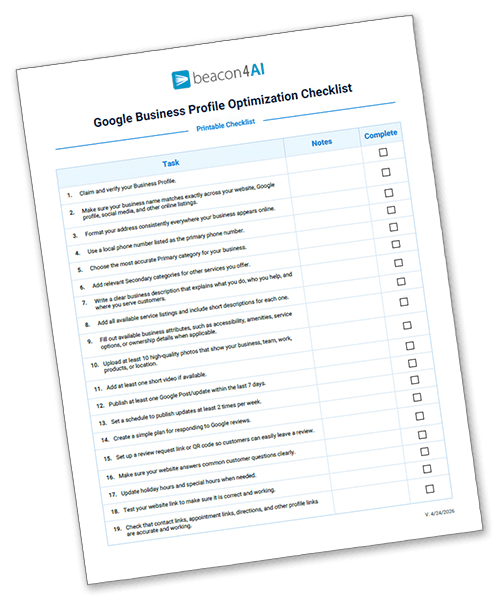
Get a printable version of the Google Business Profile Checklist
Frequently Asked Questions
How long does it take to see results after optimizing my Google Business Profile in New Hampshire?
Most businesses see movement in local search rankings within 4 to 8 weeks of completing a full GBP optimization. The timeline depends on how competitive your category is in your area and how active your profile becomes after optimization. Rural NH markets tend to respond faster than more competitive corridors like the Manchester or Nashua metro areas.
Do I need a physical address to rank on Google Maps in New Hampshire?
No. Service-area businesses can hide their physical address and set a service area by town, city, or region instead. This is common for contractors, mobile services, cleaning companies, and home-based businesses throughout NH. You will still be eligible to appear in local search results for the towns within your defined service area.
Can I have one Google Business Profile for multiple NH locations?
Yes. Each physical location should have its own separate GBP listing with its own unique address, phone number, and content. Managing multiple listings is more work, but it significantly expands your local search footprint across the state.
What should I do if a competitor is reporting fake reviews or spamming keywords in their business name?
You can report these violations directly through Google Business Profile's support tools. Google does take action on policy violations, though enforcement timelines vary. Focus primarily on building the quality signals on your own profile rather than spending energy monitoring competitors.
How does my Google Business Profile connect to what AI assistants like ChatGPT say about my business?
AI systems crawl publicly available information, including your GBP data, your website, and your reviews. A complete, active, well-reviewed profile increases the likelihood that AI systems will reference your business accurately and positively. There is no direct integration or submission process... it happens through consistent public data across multiple sources.
Does Google now penalize keyword stuffing in business names?
Yes. As of 2026, Google actively enforces its business name policy and can suspend profiles that include keyword descriptors, location terms, or marketing language beyond the actual business name. Your profile name should match your signage and legal documents exactly.
_______________________
Customers ask AI for recommendations. Is AI recommending you... or your competitors?
The Content Strategy Tool® does 85% of the work in 120 seconds... AI-optimized article, competitive gap analysis, schema, FAQs, and social posts from one report.
Try 3 free reports → No credit card. No sales call.