Written by Debbie Anderson, Founder of Beacon4ai®
If you've noticed that search results look different lately... you're not imagining it. AI-generated answers are showing up at the top of Google, ChatGPT is recommending local services, and Perplexity is citing specific businesses by name. The rules for getting found have genuinely changed, and the good news is that small businesses are not at a disadvantage here. You just need to understand how these systems think. This approach is sometimes called Generative Engine Optimization, or GEO... and the good news is, it builds on the same marketing fundamentals you already know.

Why AI Search Is Different From Google (And Why It Matters for You)
Traditional search engines match keywords to pages. You optimize a page for "best plumber in Austin," and if your page has that phrase enough times in the right places, you have a shot at ranking. According to BrightLocal's 2026 Consumer Review Survey, 45% of consumers now use AI tools for local business recommendations... up from just 6% a year ago.
AI search engines work differently. When someone asks ChatGPT "who's the best plumber in my area for emergency calls," the AI isn't scanning for keyword density. It's synthesizing information from across the web to construct a confident, trustworthy answer. It pulls from your website, your reviews, your mentions in local publications, your Google Business Profile, and dozens of other signals... then it decides whether your business is credible enough to cite.
That shift from keyword matching to trustworthiness synthesis is the core of everything that follows.
The Platforms You're Optimizing For
Not every AI platform works exactly the same way, but the core trust signals they look for are consistent. Here's a quick orientation:
Platform | How It Surfaces Businesses | Key Signal It Prioritizes |
|---|---|---|
Google AI Overviews | Draws from indexed web content and structured data | Content structure, schema markup, page authority |
ChatGPT (with Browse) | Pulls from live web search and crawled content | Brand mentions, citation-worthy content, clear expertise |
Perplexity | Heavily citation-driven, references multiple sources | Structured answers, authoritative third-party mentions |
Claude (Anthropic) | Searches the web in real-time, plus knowledge base | Clear, factual, well-organized content |
Gemini | Integrated with Google ecosystem | Google Business Profile, structured content, local signals |
The takeaway: you don't need a different strategy for each platform. You need one solid foundational strategy that covers the signals they all care about.
Step One: Make Your Website Speak Like a Human (Not a Keyword List)
AI systems are trained on how people actually talk. They understand questions, context, and intent... not just word frequency. So the first shift you need to make is writing your web content the way a knowledgeable person would answer a question out loud.
Here's what that looks like in practice:
Use question-based subheadings. Instead of "Our Services," write "What does a full roof inspection include?" AI models are significantly more likely to cite pages that use clear question-and-answer formatting because it mirrors how users phrase their queries.
Write direct answers immediately after each question. Aim for a focused 40 to 60 word answer right under the heading, then expand with detail below that. AI systems often extract just that summary-level answer when generating a response.
Use conversational language. Write the way you'd explain something to a customer standing in front of you. Avoid jargon, overly formal phrasing, or keyword-stuffed sentences.
Format for scannability. Bullet points, numbered lists, and comparison tables aren't just good for human readers... they're easier for AI models to "chunk" and extract cleanly. Pages with clear heading hierarchies and structured formatting are measurably more likely to be cited by AI engines.
What to Do With Your Existing Pages
You don't necessarily need to start from scratch. Go through your key service pages and ask yourself: if someone asked this question out loud, would my page actually answer it clearly and quickly? If the answer is no, restructure the page around the questions your customers actually ask you. These questions are happening every day in our contact form, phone calls, conversations with your team and intake conversations. These are goldmines for what kinds of questions you need to have on your website.
Step Two: Build the Trust Signals AI Systems Look For
Formatting your content correctly is necessary but AI systems also evaluate whether your business is trustworthy enough to cite... and that judgment is based on signals outside your website as much as inside it.
Think of it this way: if a friend asked you to recommend a reliable contractor, you wouldn't just read their website. You'd think about whether anyone else you trust has mentioned them, whether they've been written up somewhere credible, and whether their business seems consistently active. AI systems reason through the same logic.
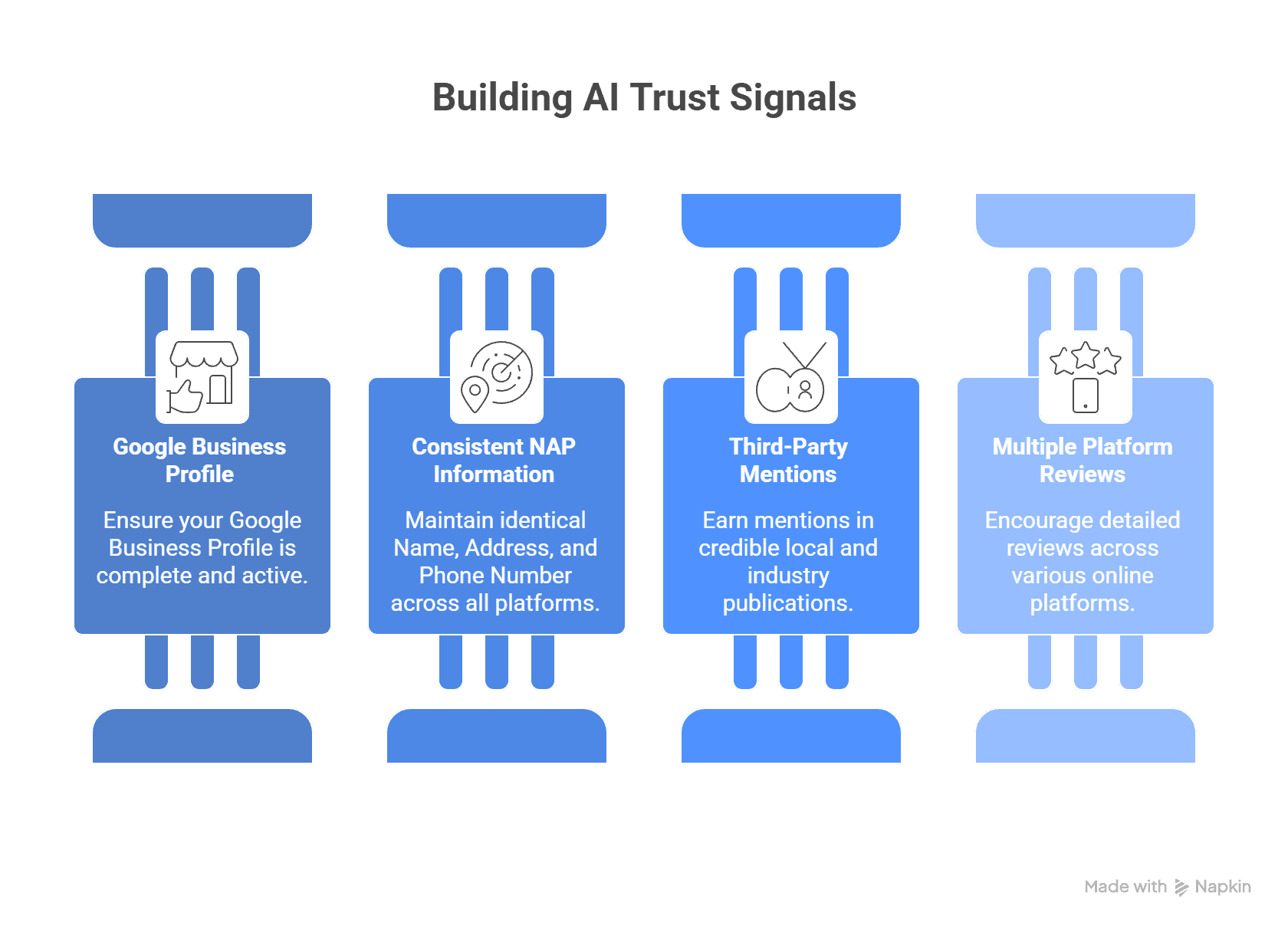
Here's how to build those trust signals:
Your Google Business Profile
If you haven't fully built out your Google Business Profile, this is your single highest-priority task. Gemini draws directly from it, and other AI systems use it as a basic credibility check. Make sure your business category, hours, services, and description are complete and current. Respond to reviews. Post updates regularly. An active, complete profile signals to AI systems that your business is real, operational, and engaged.
While you're at it, claim your Bing Places listing too. ChatGPT uses Bing's search infrastructure when browsing the web, so having accurate, complete business information there directly feeds into what ChatGPT finds when someone asks for a recommendation.
Consistent NAP Information Everywhere
NAP stands for Name, Address, Phone Number. AI systems cross-reference your business information across multiple sources. If your address is listed differently on your website, your Yelp profile, and a local directory, that inconsistency is a trust signal... and not a good one. Audit every place your business appears online and make sure the information is identical.
Pay special attention to data aggregators and directories you may not think about. Research shows that ChatGPT pulls a significant portion of its local business data from sources like Foursquare and Yelp, not just Google. If your business isn't accurately listed in these secondary directories, you could be invisible to AI even if your Google profile is perfect.
Earn Mentions in Third-Party Sources
This is the step most small businesses skip entirely. When a local news outlet writes about you, when a blogger in your industry references your work, when a podcast features you as a guest... those mentions tell AI systems that real humans and credible sources consider you worth referencing. Actively pursue:
Local press coverage (even small community publications matter)
Guest articles or contributions to industry publications
Podcast appearances or interviews
Mentions from complementary local businesses
Chamber of commerce or business association listings
One genuine mention in a credible local publication is worth gold to your AI search visibility.
For a detailed walkthrough of how to earn these local mentions in New Hampshire specifically, see our guide to getting local backlinks without hiring an agency.
Reviews Across Multiple Platforms
AI systems read reviews. Not just to assess your rating, but to understand what you do, who you serve, and what you're known for. Encourage satisfied customers to leave detailed reviews that describe the specific service they received. "Great plumber" helps less than "Called them for a burst pipe emergency at 9pm and they had it fixed within two hours." That kind of specific, natural language review feeds directly into how AI systems understand and describe your business.
Read more about Google Reviews.
Step Three: Structure Your Content so AI Can Extract and Cite It
Beyond the basics of clear writing, there are specific structural choices that make your content much easier for AI systems to extract and quote confidently.
Schema Markup
Schema markup is code added to your website that labels your content for machines. It tells search engines and AI systems exactly what type of information is on your page. The most valuable schema types for small businesses include:
LocalBusiness schema (your name, address, hours, service area)
FAQPage schema (marks up your frequently asked questions so they're machine-readable)
Service schema (describes the specific services you offer)
Review schema (displays your ratings in search results)
You don't need to write this code yourself. Most website platforms have plugins or built-in tools for adding schema, or your web developer can implement it quickly. The SEO benefit is real, but the AI discoverability benefit is equally significant.
FAQ Sections Done Right
A well-built FAQ section is one of the highest-value pieces of content you can add to any service page. The key is writing questions the way your actual customers phrase them... not the way a marketer would phrase them. Pull questions from your email inbox, your intake calls, your reviews, and the questions your front-desk staff hear every day. Those are the exact questions AI systems are being asked, and your answers can become the cited source.
Fresh, Accurate Content
Outdated information works against you. Stale statistics, broken links, and old service descriptions reduce your credibility in AI systems' evaluation. Build a habit of reviewing your key pages quarterly. Update any facts, pricing references, or process descriptions that have changed. AI systems treat content freshness as a quality signal.
Step Four: Build a Presence Beyond Your Own Website
AI engines pull from the entire web, not just your domain. This means your visibility is partly a function of how much of the broader internet acknowledges that you exist and are credible.
A few high-impact channels to prioritize:
Industry directories and association listings relevant to your field
Local business directories (not spam directories... legitimate ones that real people use)
Social media platforms where your ideal customers spend time, kept consistently active
Collaborative content with other businesses, influencers, or creators in adjacent niches
Your own email newsletter or content published on reputable platforms (LinkedIn articles, for example)
The goal isn't to be everywhere. It's to have a consistent, credible footprint across the places that AI systems treat as authoritative sources.
The Prioritized Action Sequence (Start Here if You're Overwhelmed)
If you're looking at all of this and wondering where to actually begin, here's a practical sequence based on impact:
Priority | Action | Time Investment |
|---|---|---|
1 | Complete and optimize your Google Business Profile | 1 to 2 hours |
2 | Audit and unify your NAP information everywhere online | 2 to 3 hours |
3 | Rewrite your top 3 service pages with question-based structure | 3 to 5 hours |
4 | Add FAQ sections to every service page | 2 to 4 hours |
5 | Ask satisfied customers for detailed, specific reviews | Ongoing |
6 | Pursue one local press mention or third-party feature | 2 to 4 hours |
7 | Implement basic schema markup sitewide | 1 to 2 hours (with help) |
8 | Build a consistent content publishing habit (blog, social media, videos) | Ongoing |
You don't need to do all of this at once. Start with steps one through three, and you'll already be ahead of the vast majority of small businesses competing for AI-generated recommendations.
Need help with your blog? Beacon4ai's Content Strategy Tool creates affordable articles based off of live competitor data. Find out more >>>
A Note on What This Isn't
AI search optimization is not about gaming a system. It's not about stuffing your pages with questions, faking reviews, or manufacturing mentions. AI systems are becoming better at detecting low-quality signals, and tactics that looked like shortcuts have a short shelf life.
What actually works... and what keeps working... is communicating clearly, demonstrating genuine expertise, and building a consistent presence that real people and credible sources have validated. That's not a trick. That's just being a trustworthy business.
The businesses that will consistently show up in AI-generated answers are the ones that AI systems can confidently describe, verify, and vouch for. Your job is to make that as easy as possible.
Frequently Asked Questions
Does my business need to be on every AI platform separately?
No. You don't create separate profiles or accounts for ChatGPT, Perplexity, or Claude the way you might on social media. These platforms pull information from the web automatically. Your job is to make sure your website, Google Business Profile, and third-party mentions are accurate and well-structured so that any AI system that crawls the web finds consistent, credible information about you.
How long does it take to start showing up in AI search results?
There's no guaranteed timeline, and AI systems don't publish one. That said, changes to your Google Business Profile can be reflected fairly quickly since Gemini draws from it directly. Website content improvements and new third-party mentions may take weeks to months to influence AI recommendations, since these systems need time to crawl, index, and weigh new information.
Is traditional SEO still worth doing if AI search is taking over?
Yes, and for an important reason: most AI systems that browse the web still rely on search engine indexes to find content. Pages that rank well in traditional search are also pages that AI systems are more likely to discover and cite. Good SEO and good AI search optimization are not competing strategies... they reinforce each other. The main difference is that AI optimization adds a layer of trust-building and content structure that pure keyword SEO doesn't cover. For a plain-language breakdown of how the two differ, see SEO vs AEO explained.
What's the single most important thing I can do today?
Search for your business on ChatGPT and Perplexity right now. Ask "who are good [your service type] in [your city]?" and see whether your business appears. Then ask "tell me about [your business name]" and see what the AI says. That gap between what the AI knows and what you want it to know is your optimization roadmap. Start there.
Do customer reviews actually influence AI recommendations?
Yes, meaningfully so. AI systems read and synthesize review content to understand what a business does, who it serves, and how reliable it is. Reviews across Google, Yelp, and industry-specific platforms all contribute. The most useful reviews for AI visibility are specific and descriptive... they name the service, describe the experience, and use natural language that matches how someone might phrase a search query.
——————————————
Your customers are already asking AI for help. Is AI recommending you... or your competitors? Beacon4ai's Content Strategy Tool generates AI-optimized content frameworks in 120 seconds, giving you the structure, keywords, and schema code you need to get found... all based on live data.. Try it for Free.
Last Updated: 3/7/2026