
Written by Debbie Anderson, Founder of Beacon4ai
This is big news if you care about how your business shows up where people seek answers ... not just links. For years, local visibility has focused on rankings, impressions, and clicks. Most businesses have invested heavily in Google Business Profile, Search Console, and traditional SEO metrics. Those absolutely still matter. But search visibility is no longer confined to blue links and map packs.
A new layer has emerged... one shaped by AI-generated answers from platforms like Chatgpt, Perplexity, Claude and Google AI Overviews.
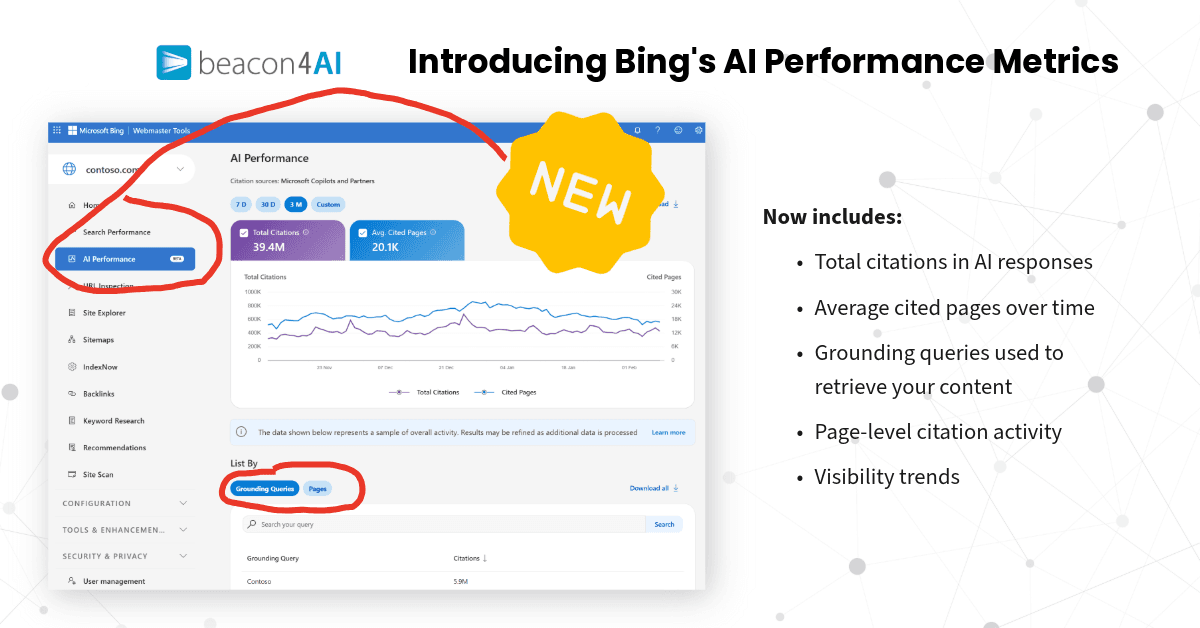
What Microsoft Announced: AI Citation Tracking in Bing Webmaster Tools
On February 10, 2026, Microsoft introduced an AI Performance dashboard inside Bing Webmaster Tools. For the first time, publishers and business owners can see when and how often their website content is cited in AI-generated answers across Microsoft Copilot, Bing's AI summaries, and select partner integrations.
Microsoft described this as an early step toward Generative Engine Optimization (GEO) tooling, a term the industry is using to describe the practice of optimizing content so AI systems find, understand, and reference it when generating answers. This reporting does not measure rankings or traffic. Instead, it measures whether your content is being used as a source when AI systems generate responses. That distinction matters.
What the AI Performance Dashboard Actually Tracks
The AI Performance dashboard provides four core metrics that give website owners a window into how their content participates in AI-driven discovery:
Total Citations - the number of times your content appears as a source in AI-generated answers during a selected time period.
Average Cited Pages - the daily average of unique pages from your website that AI systems reference.
Grounding Queries - the key phrases the AI used when retrieving your content. Think of these as the AI's version of search queries. Microsoft notes this data currently represents a sample and will continue to be refined.
Page-Level Citation Activity - which specific URLs on your site are most often referenced, making it easy to see what content AI systems value most.
There is also a timeline view showing how citation activity changes over time, so you can spot trends and measure the impact of content updates.
Why This Matters Beyond Bing
Many businesses have a complete Google Business Profile but have never claimed or verified their Bing Places listing. That gap does not affect Google rankings, but it can influence how confidently AI systems interpret and reference your business information. Microsoft's own announcement specifically recommends that local businesses register with Bing Places for Business to ensure details like address, hours, and contact information remain current and eligible for inclusion in AI-generated responses.
Search engines and AI systems rely on structured, verified data to reduce ambiguity. If your business details are clear and consistent in one ecosystem but incomplete in another, you create uneven visibility across platforms.
Visibility Now Operates in Layers
This does NOT mean abandoning traditional SEO. It does NOT mean Bing replaces Google. It means visibility now operates in layers. Traditional search results, local map listings, AI summaries, and conversational responses all intersect. The businesses that prepare for all layer's position themselves more strongly for what comes next.
How to Start Building AI-Citable Content
Bing Places strengthens your business identity within Bing's ecosystem. But identity alone does not generate citations. AI systems pull from content that answers questions clearly and confidently. That means your website needs more than static service pages.
It needs ongoing, structured, answer-driven content that reinforces your expertise and expands the range of questions your business can credibly address.
Strategic blog content plays a critical role here. AI systems do NOT cite marketing slogans.
They cite explanations.
They cite clarity.
They cite well-structured answers that demonstrate depth and authority.
When your website consistently publishes content that is clear, specific, and designed to answer real questions, you increase your eligibility to be referenced in AI-generated answers. This is especially urgent as AI agents begin completing purchases on behalf of consumers… being cited is now directly tied to revenue. For a step-by-step guide to structuring blog posts that AI systems find and recommend, see our walkthrough on optimizing blog posts for AI search visibility.
Microsoft's content guidance reinforces this. Their announcement recommends strengthening depth and expertise, improving structure with clear headings and FAQ sections, supporting claims with evidence, and keeping content fresh and accurate. These are the same principles that drive Answer Engine Optimization (AEO) ... the practice of structuring content so AI systems can find, understand, and cite it.
Keeping Your Content Fresh with IndexNow
Microsoft also highlighted IndexNow as a way to keep content fresh across search and AI experiences. IndexNow notifies participating search engines whenever content is added, updated, or removed, helping AI systems reference the most current version of your pages. If your website platform supports IndexNow, enabling it is a simple FREE step that can improve how quickly AI systems pick up your latest content. It's worth the time to set this up. You can learn more at indexnow.org.
What This Means for Your Content Strategy
This is why content strategy must evolve beyond keyword targeting and traffic goals. In the era of AI-generated answers, visibility is not only about being found ... it is about being usable. The businesses that are cited are the businesses that are understood. And understanding is built through structured, consistent, high-quality content.
If you are unsure where to start, the first steps are straightforward:
claim your Bing Places listing
verify your Bing Webmaster Tools account
check the new AI Performance dashboard to see if your content is already being cited.
Then look at your website through the lens of AI. Does it answer real customer questions? Is it structured with clear headings and specific information? Does it include FAQ content that AI can extract and reference?
These are the habits that build AI visibility over time. Not overnight, not through shortcuts, but through consistent, answer-driven content that earns trust from both your customers and the AI systems they are starting to rely on. Our guide to writing answers that AI systems cite and trust shows exactly how to structure FAQs for AI visibility.
Frequently Asked Questions
What is the Bing AI Performance dashboard?
The AI Performance dashboard is a new feature inside Bing Webmaster Tools, launched in public preview on February 10, 2026. It shows website owners how often their content is cited as a source in AI-generated answers across Microsoft Copilot, Bing AI summaries, and select partner integrations. It tracks total citations, average cited pages, grounding queries, and page-level citation activity.
What is Generative Engine Optimization (GEO)?
Generative Engine Optimization (GEO) is the practice of optimizing your content so that AI-powered search systems can find, understand, and cite it when generating answers. Microsoft referenced GEO directly in their announcement, calling this dashboard an early step toward GEO tooling. GEO builds on traditional SEO by focusing on AI citation and inclusion rather than just rankings and clicks.
Does this replace Google Search Console?
No. Bing Webmaster Tools and Google Search Console serve different ecosystems. Google Search Console tracks your performance in Google search results, including AI Overviews. Bing's new AI Performance dashboard specifically tracks citations across Microsoft's AI experiences. For comprehensive visibility, local businesses should monitor both platforms.
What are grounding queries in Bing Webmaster Tools?
Grounding queries are the key phrases that Bing's AI system uses when retrieving content to include in AI-generated answers. They are not the exact words a user types, but rather how the AI translates user intent into search retrieval. Microsoft notes this data currently represents a sample that will continue to be refined throughout 2026.
How can a small business improve its chances of being cited by AI?
Focus on publishing clear, structured content that directly answers real customer questions. Use descriptive headings, include FAQ sections, support claims with specific details, and keep your content updated.
Claim your Bing Places listing and verify your site in Bing Webmaster Tools.
Consistent, answer-driven content is the foundation of AI visibility.
Is Bing Webmaster Tools free?
Yes. Bing Webmaster Tools is free to use. Any website owner can create an account, verify their site, and access the AI Performance dashboard at bing.com/webmasters.
Does the AI Performance dashboard show click-through data?
Not yet. The current dashboard shows citation counts and trends but does not reveal how many users clicked through from AI-generated answers to your website. Microsoft has indicated the dashboard will continue evolving throughout 2026, and industry observers expect click-through data to be added in future updates.
___________________
This article explained why AI visibility matters thru the use of well structure content. The Beacon4ai® Content Strategy Tool helps you create that content in an affordable, time-saving way.
Enter one customer question (mimic's a search on AI) and in 120 seconds get:
an AI-optimized blog article
5 strategic FAQs
ready-to-paste schema code
internal linking guidance
content roadmap
plus every report gives you weeks of ready-to-post social media content.
No more blank screens. No more wondering what to write. Try it free ... 3 reports, no credit card. This is the kind of content AI cites in a response.