
Found.
YOUR BRAND, DISCOVERED BY AI
Issue 005 / April 2026 • Citation Signals, Schema Markup, and Google's Ask Maps

There's still a small pile of snow in my yard here in the White Mountains... but the sun is warm, the mud is real, and I've been sneaking outside for yard work whenever I can. Spring is slow to arrive in New Hampshire, but it always does. I'll take it.
It's been a busy season on the work side too. I've been spending a lot of time with clients across all kinds of industries lately, all saying the same thing... they know they need to add that AEO layer to their business but they're just not sure how to do it themselves. So more and more, they're asking me to partner with them to update their Google Business Profiles, add blog content and basically do a custom audit based off their situation. Honestly, I built the Content Strategy Tool® so businesses could do this themselves affordably, and they can, but I'm also learning a lot by getting my hands into it directly with clients. So I feel that sharing this is going to be helpful to you.
One moment this week was pretty memorable for me. I was Googling something and a topic came up that one of my clients had literally just published a blog post about... 4 days earlier. And right there in Google's AI Overviews was their website, cited as a source. Four days. That's it. The content was fresh, it was structured the right way, and AI picked it up almost immediately. Moments like that are why I do this work.
This issue of Found is full of things I've been seeing in the field. A real case study from an Asheville client with a home goods shop. A breakdown of Google's new Ask Maps feature and what it means for local businesses. And a term worth adding to your vocabulary: citation signals. It ties everything together.
Let's dig in.
~ Debbie
________________________
IN THE SPOTLIGHT

Industry Spotlight
Retail • Specialty Home Goods Shop
An artisan home decor shop in Asheville, NC had everything going for it, a long established presence in one of the most recognized craft markets in the country. And almost no visibility in an AI search.
Searches such as "where can I find unique handmade home decor in Asheville". What was ranking when we tested it was... a destination tourism site, a personal lifestyle blog, a real estate company's blog post... AND Yelp.
Not a single result came from an actual artisan or handmade decor seller.
A realty company was outranking actual home decor businesses for a home decor shopping query. Not because they knew more about handmade ceramics... but because they had published a page that answered the question, and the shop owners hadn't.
Here's what the gap looked like in practice:
Every competing page was organized the same way — lists of shop names by neighborhood, brief descriptions, move on. None of them explained how to shop for handmade goods, what makes something genuinely handmade versus mass-produced, or why Asheville's craft scene is worth seeking out. That expertise lived inside the heads of the actual makers and shop owners. It just wasn't on their websites.
And Yelp is actively being cited which means the language in Yelp business descriptions and customer reviews is being read and quoted in AI-generated answers.
*Important take-aways on the Yelp topic... Shops with thin, bullet-point descriptions are not getting cited. Shops whose customers leave specific, descriptive reviews were showing up.
Here's what we changed for this shop:
Published a detailed blog... a guide to shopping for handmade home decor in Asheville, written from the perspective of someone who actually makes and sells it, covering quality signals, neighborhood differences, and how to recognize authentic craft
Rewrote the Yelp business description in full sentences using specific language about the types of pieces carried and what makes them local... the way a helpful person would describe the shop, not a feature list
Added a FAQ section to the website answering the questions customers ask most... which happen to be exactly the questions AI systems are built to answer
Updated Google Business Profile categories and attributes to reflect what the shop actually offers
Within weeks of making these updates, the shop started appearing in AI-generated answers (and ranking higher in Google) for handmade home decor searches in Asheville. The owner shared with us:
"We cleaned up our business online, added fresh content to our blog, and I didn't expect to see results that fast."
THE TAKEAWAY
The businesses showing up in AI answers for your category may not be the best ones. They're just the ones that shared that info in the right way. Your expertise is the content gap. Fill it.
READ: How to Audit Your Website Content for AI Visibility →
_______________________________
NON-NEGOTIABLES
Your Schema Markup
If you've been following along, I've covered some of the most fundamental AI visibility requirements: your Google Business Profile, your Bing Places listing, your NAP consistency, and your SSL certificate. This issue, we're talking about something that sits underneath all of that... the invisible layer that helps AI systems actually understand what your business is and what it does.
That layer is called schema markup.
Schema markup is a piece of structured code that you (or most likely your web developer) add to your website. It doesn't change anything visitors see. What it does is give AI systems, Google, Bing, ChatGPT, Perplexity, and others a clear, machine-readable description of your business... your name, address, hours, services, reviews, and more.
Without it, AI tools have to guess. They read your text, make inferences, and decide what your business is based on context clues. That's fine for a straightforward query. But when someone asks "find me a family-owned HVAC company in [city] with emergency service available," the businesses with schema that explicitly states those things have a real advantage.
You don't need schema on every page to start. Focus here first:
☐ LocalBusiness schema on your homepage or contact page. This is the foundation. It tells AI your business name, address, phone number, hours, and what category you're in.
☐ FAQPage schema on any page where you have a Q&A section. FAQ content is among the most frequently cited content in AI-generated answers... and FAQ schema makes it even more extractable.
☐ Service schema on your service pages. If you offer specific services, describing them in schema helps AI systems match you to the right queries.
☐ Check your work using the free Google Rich Results Test at search.google.com/test/rich-results. Paste your URL. It takes about 30 seconds and shows you exactly what Google can read.
☐ Ask your web developer or website platform if schema is already present on your site. Many platforms (Squarespace, Wix, WordPress with Yoast, Framer) either include it automatically or offer plugins that handle it.
You do not need to understand the code to get value from schema. You do need to make sure it's there.
READ: Schema Implementation Guide →
_______________________________
INDUSTRY WATCH
Google • Launched March 12, 2026
Google Maps Just Started Answering Questions Like a Person
Google launched a new feature called Ask Maps in mid-March, and if you run a local business, it's worth understanding.
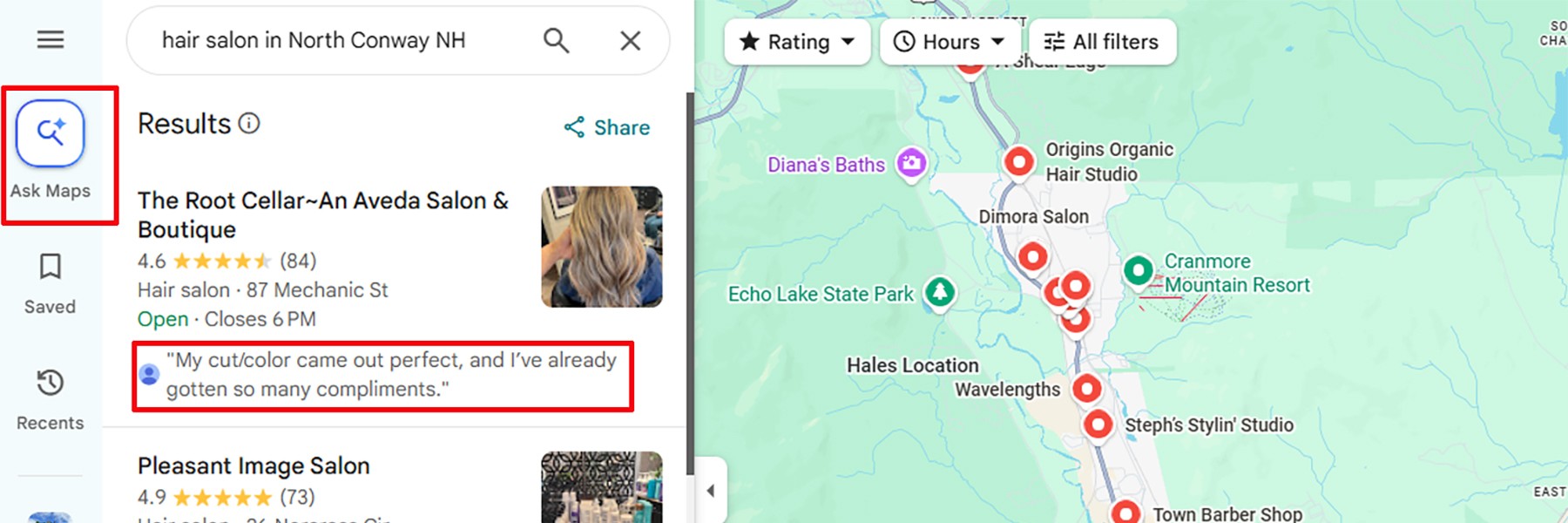
Here's what changed:
Before Ask Maps, if someone opened Google Maps looking for a hair salon, they typed "hair salon near me" and got a list. Now they can ask something like "find me a hair salon in North Conway that's good with color and has availability this week"... and Google's AI generates a personalized answer, with recommendations, a map, and directions built in.
The feature is powered by Gemini, Google's AI model. It draws its recommendations from Google Business Profile data, community reviews, photos, and business attributes. No keywords. Just a conversational question.
What this means for your business:
Ask Maps doesn't just return the closest business or the one with the most reviews. It tries to match the specific language of what the searcher asked to your profile and review content. A salon might rank well for "hair salon near me" but not appear when someone asks for "good with color" if nobody has mentioned that in their reviews or profile... even if they're the best colorist in town.
This is a direct extension of everything we talk about in this newsletter: complete profiles, specific review content, accurate business attributes, and good information on your website all feed into how AI tools discover and recommend you.
What to do right now:
Open your Google Business Profile and check your Attributes. Does your profile include things like the services you specialize in, whether you're good with color, if you take walk-ins, or whether you're kid-friendly? These are the details Ask Maps is reading.
Look at your most recent reviews. Do they mention the specific things that make your business worth choosing? Google surfaces specific, descriptive reviews — not generic ones. The more specific your reviews, the better AI can match you to the right search.
Ask Maps currently has no paid placements... which means the businesses that show up are getting there entirely on the strength of their profile and reputation. That's a good reason to invest in that foundation now.
_______________________________
TWO-MINUTE WIN
Take a Hard Look at Your Google Business Profile Photos
Open Google Maps on your phone and pull up your business listing. Tap through your photos.
When did you last add one? Do they show what it actually feels like to be a customer... your space, your work, your people? Or are they the same three images you uploaded when you first claimed the listing?
Ask Maps pulls from photos when generating recommendations. So does Google's AI Overview. A profile with recent, specific, high-quality images tells AI (and the people searching) a lot more about your business than an empty photo tab or outdated shots from three years ago.
Add one photo today. Something recent of your space, a finished project, a product, your team. It takes two minutes and it's one more signal that your business is active, current, and worth recommending. Then make it a habit. Once a month is a good start... once a week is even better. It doesn't need to be professional. It just needs to be real and recent.
_______________________________
REAL TALK
THIS ISSUE'S QUESTION
"I've been told I should be blogging for SEO. But I honestly have no idea what to write about. Where do I even start?"
Start with the questions your customers ask you out loud. Not keyword research. Not what sounds professional. The actual questions that come up in your store, your inbox, your phone calls, week after week.
Here's a real example of what I mean. Think about my client from the Industry Spotlight... the artisan home decor shop. What do customers ask when they walk in their shop? Things like:
"How do I know this is actually handmade?"
"What's the difference between the pieces downtown versus the ones in the River Arts District?"
"How do I take care of handmade pottery?"
Those aren't just great customer service questions. They're blog posts! When you look at what AI systems are actually being asked about handmade home decor in Asheville, those are exactly the gaps that no competitor has filled. The tourism sites list shops. The travel blogs name neighborhoods. Nobody with actual expertise has written how to tell if something is genuinely handmade or what makes Asheville's craft scene worth seeking out. That knowledge lives with the makers and shop owners... and it's not on anyone's website yet.
That's your opportunity. In any industry.
The plumber who explains what "water pressure issues" actually means and when it's serious. The accountant who answers "what happens if I miss a quarterly payment." The dog groomer who covers "how often does my breed actually need a trim." AI systems are built to surface answers to real questions. When your content is that answer, written the way you'd explain it to a customer... you become the source AI recommends.
Think about what you answered this week. Start there.
And here is my shameless plug - Not everyone has the time, resources, or the skill to research and write blog posts. That is why I built the Content Strategy Tool ® for small business owners and their teams. It's not an AI Writer. It's a competitor analyzing little monster that looks for best ways to get you recommended to customer looking for your products or services. It removes the need to learn how to learn a dashboard, become an SEO/AEO expert, or do all the research necessary to actually publish a blog that is effective. The CST® does it all for you.
Ok, I'm done now. Hee hee. But seriously, check it out for FREE.
_______________________________
DIGITAL LOCKBOX
Your Social Media Accounts
Your Facebook page, Instagram profile, LinkedIn company page, YouTube channel... these accounts contain years of content, an engaged following, and a reputation you cannot rebuild from scratch. In some cases, they have real monetary value. And in more cases than anyone wants to admit, the business owner (or their team) isn't the one who actually controls them.
Facebook pages are typically tied to a personal profile. Whoever's personal account created the page often holds top-level admin access. If that person was a marketing agency, a social media manager, or an employee who left two years ago... they may still have it. Instagram is connected through Meta, same situation. LinkedIn company pages require individual admins. YouTube channels are often tied to a personal Google account depending on how they were set up... which means if that person leaves, access can go with them.
This matters more than most business owners realize - especially if you ever plan to sell. Followers don't automatically transfer when a business sells. Accounts do... but only if you own them.
To-Do Checklist
☐ For each platform you're on, do you know whose personal account or email address is listed as the primary owner or admin?
☐ Can you log in to each one right now without calling someone?
☐ Are the login credentials tied to a business email you control... or someone else's personal address?
☐ On Facebook, go to Settings → Page Setup → Page Access. You'll see everyone with Full Control or Partial Control of your page. On Instagram, access is managed through Meta Business Suite at business.facebook.com under People and Assets. If you see names of people who no longer work with you on either platform, remove their access today.
PRO TIP 💡
Facebook/Meta now requires or strongly encourages two-factor authentication for business pages... and that 2FA is tied to the personal account of whoever has admin access. If someone else's phone is the authenticator for your business page, that's a problem worth fixing.
Your social media accounts are a business asset. Treat them like one and add your current info into your DIgital Lockbox. Don't have one? Download link is below.
New to Found.? Catch up on previous Digital Lockbox topics in our Newsletter Archive >>
The Digital Lockbox Guide below helps you track every critical account, login, and ownership detail your business depends on. We discuss a new item every issue.
🔒 Free download for Found® subscribers
The Digital Lockbox Guide... 31 pages of practical steps to make sure you always own and control your online presence. Yours as a thank you for being here.
Download Your Digital Lockbox Guide >>>
___________________________
THE WORKSHOP
🔒 Exclusive for Content Strategy Tool Subscribers
What a Real Report Looks Like in the Wild
This issue's Industry Spotlight was built around an actual Content Strategy Tool® report.
The query: "where can I find unique handmade home decor in Asheville NC"
So let's talk about what the report surfaced and how to read findings like these in your own work.
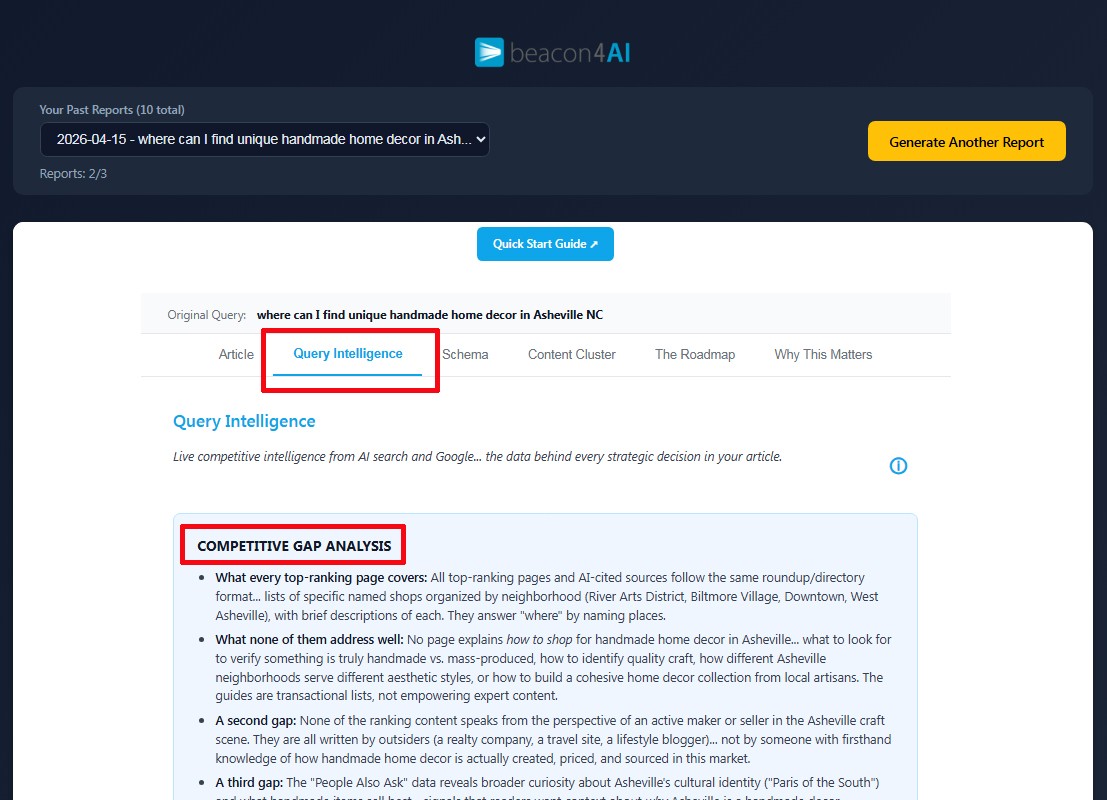
Query Intelligence - The Competitive Gap Analysis section showed that every top-ranking page and AI-cited source for this query followed the exact same format: a list of shop names organized by neighborhood. That's it. Nobody was explaining how to shop for handmade goods, how to evaluate quality, or what makes this market worth seeking out. That's an expertise gap...and it's the kind of finding that tells you exactly what to write.
When you see this pattern in your own reports, where all competitors are doing the same thin thing, that's your signal to go deeper. Don't write the list. Write the guide. That is where your CST® article is addressing THAT gap. It's already written for you. Now add it to your blog.
The Yelp citation finding. This one could show up in the Competitive Intelligence Insights section. For our query example, Yelp appeared in both the AI citation sources and the organic SERP (Traditional Google Search) results for this query. AI systems were actively pulling from Yelp to answer it.
Your Yelp business description is content AI reads.
If your Yelp business description it's written in bullet points or vague phrases, it doesn't extract well. Rewrite it in full sentences the way you'd describe your business to a helpful stranger. Specific language. Real details. That's what gets cited.
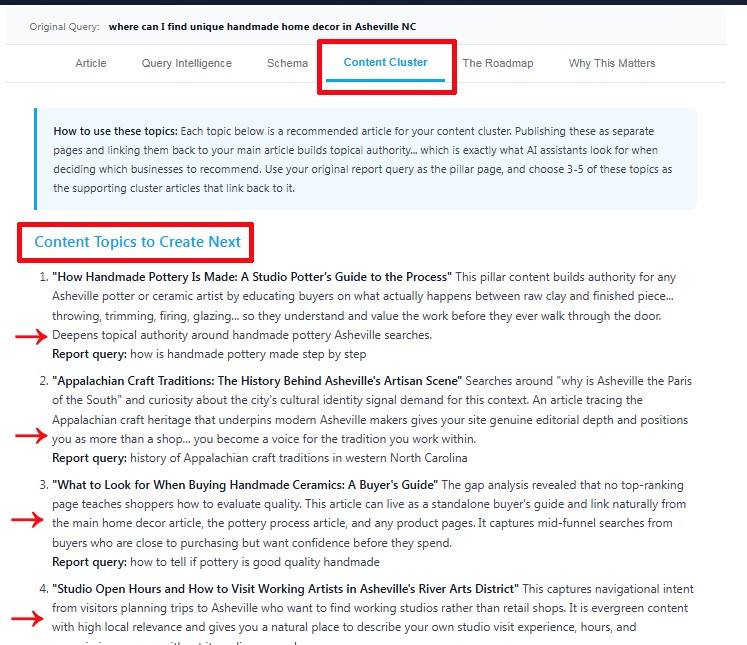
The Content Cluster. The report generated five follow-on article topics (4 are shown above), each one rooted in a question real customers are already asking: how pottery is made, how to evaluate quality, how to care for handmade pieces. These aren't invented topics... they're gaps the data identified. When you're planning your next three months of content, your CST content cluster is your editorial calendar. Run the report, look at the cluster, pick three. When you post as a blog, do your internal linking to all relavent posts to develop your topical authority. Very powerful stuff.
The Asheville shop has a clear content roadmap now. So does any business that runs a report for a query they should be winning.
_______________________________
Curious about the Content Strategy Tool?
Try it free... 3 reports, no credit card required→
_______________________________
TRENDING AI TERMS

Citation Signals
When an AI system generates an answer in ChatGPT, Perplexity, Google AI Overviews, or Ask Maps, it doesn't pull information randomly. It pulls from sources it has determined are credible and relevant. Citation signals are the data points AI systems use to make that determination.
Think of each citation signal as a little "hello" from your business to the AI systems deciding who to recommend. The more hellos, the harder you are to overlook.
Citation signals include things like:
how consistently your business name, address, and phone number (NAP) appear across directories
the volume and specificity of your customer reviews
whether authoritative third-party sites mention your business by name
how completely your Google Business Profile is filled out
whether your website directly answers the kinds of questions people are asking
This issue has been full of citation signal examples, even if we haven't used that term until now. The Asheville home decor shops that weren't showing up in AI answers? Weak citation signals: thin Yelp descriptions, generic reviews, no content that established expertise. The ones that were showing up? Strong citation signals:
specific review language
complete directory profiles
content that matched what searchers were actually asking
Why this matters for your business:
You can't directly tell an AI to recommend you. But you can build the signals it looks for. Every complete directory listing, every specific customer review, every FAQ page you publish is a citation signal. Stack enough of them and AI systems start treating your business as the credible source it already is.
_______________________________
How to Leave a Google Review... Etiquette Everyone Should Know About
We've spent this whole issue talking about citation signals and reviews are one of the most powerful ones. So, it felt like the right moment to talk about what makes a review genuinely useful and the etiquette fo writing a review.
The short version: specific beats generic every time. A review that describes what you actually experienced gives the next customer something real to go on... and gives AI systems something worth citing.
There's also a bit of etiquette worth knowing:
around timing
star ratings
how to handle an experience that didn't go perfectly
It's the kind of thing that makes your review more credible and more helpful to everyone reading it... business owners and other customers alike.
📖 READ: How to Leave a Google Review the Right Way →

Thanks for sticking around until the end!
I know these newsletters can be long but my hope is there is something for every reader out there. Like that saying goes... if you learn one thing a day, you're ahead of the game.
Wishing you much success and if you'd like to reach out directly for a conversation about how I can help your business thrive, give me a shout at Hello@Beacon4.ai
Get Found. in your inbox.
Practical AI visibility tips for small businesses. Free, biweekly.