Written by Debbie Anderson, Founder of Beacon4ai
With AI Overviews now appearing in over 25% of all Google searches and more than 800 million people using ChatGPT every week, the question is no longer whether AI search matters. It’s whether your business is showing up in it.
If you have been wondering whether maintaining a blog is still worth your time now that AI tools are answering so many search queries, you are not alone. The short answer is yes... and the longer answer is that a well-structured blog is actually one of the most powerful tools you have for getting your business cited by ChatGPT, Perplexity, Google’s AI Overviews, and Gemini. Here is exactly why that is, and more importantly, how to make it work for you.
What the Data Says: Blogging Is the #1 Content Type AI Cites
Before we get into the how, let’s look at the numbers. Recent research paints a clear picture of why blogging matters more now than it ever has:
Blog content is the #1 page type cited in AI Overviews, according to Conductor’s 2026 benchmark study. Not service pages. Not homepages. Blog posts.
Corporate blogs account for 39% of all AI citations, compared to just 26% for news sites (Search Engine Land). That means your blog has a better chance of being cited than a news article.
AI-driven visitors convert at 4.4x the rate of standard organic visitors (Semrush). People arriving through AI citations are further along in their decision-making... they are ready to act.
Small businesses that blog see 126% more lead growth than those that don’t, and businesses that prioritize blogging are 13x more likely to see a positive ROI (HubSpot).
Those numbers are not just interesting... they are a roadmap. The rest of this post will show you exactly how to follow it.
Why AI Search Changes Everything (And Why Blogs Are More Important Than Ever)
When someone types a question into Google today, they often see an AI-generated summary at the top of the page before they see any traditional blue links. When someone asks ChatGPT or Perplexity a question about your industry, those tools are not making up answers... they are pulling from real, published web content.
Here is the key insight: AI systems need a source. They look for pages that clearly, confidently, and thoroughly answer a question. Static service pages with a few bullet points rarely qualify. A well-written blog post that actually explains something? That is exactly what AI tools are looking for.
This shift has a name. Marketers call it Generative Engine Optimization (GEO)... the practice of structuring your content so that AI systems are more likely to surface it in generated responses. Blogging sits at the very heart of a strong GEO strategy.
And this is not a niche trend. The GEO market is valued at $848 million in 2025 and projected to reach $33.7 billion by 2034. Sixty percent of U.S. adults say they have already used AI to search for information. The shift is happening now, and it is accelerating.
What AI Systems Actually Look For When Choosing Sources
Understanding how AI tools select their sources helps you write content that gets chosen. Here are the qualities that consistently earn citations across platforms like Google AI Overviews, ChatGPT, and Perplexity:
Quality | What It Means for Your Blog |
|---|---|
Depth and completeness | Answers the full question, not just part of it |
Clear structure | Uses headers, lists, and short paragraphs AI can parse easily |
Demonstrated expertise | Written by or on behalf of someone with real experience |
Freshness | Regularly updated content signals an active, credible business |
Trustworthiness | Cites sources, uses accurate claims, avoids hype |
Conversational phrasing | Mirrors how real people actually ask questions |
Notice that none of those qualities require a massive advertising budget or a team of developers. They all come down to writing genuinely useful content, structured in a way that is easy to read and easy for AI to parse.
Research backs this up. According to a Growth Memo study from February 2026, ChatGPT is more likely to cite content that uses definite language (not vague), contains question-style headers, has high entity density, and uses simple writing structures. Pages with well-organized headings are 2.8x more likely to earn AI citations (AirOps).
The Real Reason Your Static Website Pages Are Not Enough
Your homepage, your about page, and your service pages are important. But they were designed to convert visitors who already found you... not to attract new ones or earn AI citations.
Here is the problem: those pages typically answer questions like “what do you do?” and “how do I contact you?” AI tools are asked questions like “how do I know if I need [your service]?” and “what should I look for when choosing a [your industry] business?” Your static pages almost never answer those questions.
A blog fills that gap. Every post you publish is an opportunity to answer exactly the kinds of conversational, question-based queries that AI systems are asked hundreds of times a day. Each post becomes a new entry point into your business... one that AI tools can find, assess, and cite.
Think of your website as a job applicant. Your static pages are the resume. Your blog is the portfolio of real work that proves you actually know what you’re talking about.
How Blogs Build the E-E-A-T Signals AI Systems Prioritize
You may have heard the term E-E-A-T... it stands for Experience, Expertise, Authoritativeness, and Trustworthiness. It was originally developed as a framework for Google’s human quality raters, but it has become a meaningful signal for AI-powered search systems as well.
How meaningful? Websites with author schema are 3x more likely to appear in AI-generated answers, according to BrightEdge. AI systems are actively cross-referencing author names against LinkedIn, professional directories, and publication history to verify credibility.
Here is how each layer connects to your blog:
Experience means demonstrating that you have actually done the work. When your blog post explains a process from the inside, shares an honest look at a common challenge, or walks through a real scenario, it reads differently than generic information. AI can detect that difference.
Expertise means covering topics with enough depth and accuracy that someone could actually learn from your content. Surface-level posts that just restate obvious facts do not move the needle. Posts that go one level deeper than what anyone else has written... those get remembered and cited.
Authoritativeness builds over time as you consistently publish on topics within your industry. AI systems assess the overall topical authority of a website, not just individual pages. The more consistently your blog covers your subject area, the stronger that signal becomes.
Trustworthiness comes from being accurate, transparent, and honest. This means not overpromising, citing information correctly, and acknowledging the limits of your own knowledge. AI tools are increasingly good at detecting content that feels promotional or misleading.
The Blogging Mistake That Kills AI Visibility
Here is where most business owners go wrong: they publish blog posts that are essentially glorified advertisements. “Why Our [Service] Is the Best in the Region” is not a blog post that AI tools want to cite. It is a sales pitch wearing a headline.
AI systems are looking for informational value. They want content that helps the person asking the question, not content that pushes the business behind the page. The more your blog answers real questions completely and honestly, the more likely it is to be surfaced in AI-generated responses.
This does not mean you cannot mention your business or your services in a post. It means the primary purpose of every post should be to genuinely inform the reader. Your business benefits as a natural consequence of that authority... not as the opening pitch.
How to Structure a Blog Post That AI Systems Can Actually Use
Structure matters more than most people realize. AI tools do not read a blog post the way a human skims it. They parse it. They look for signals that a section answers a specific question, and they extract those sections to build their responses.
According to SE Ranking’s research, pages organized into sections of 120 to 180 words between headings receive 70% more ChatGPT citations than pages with shorter, fragmented sections. And 44.2% of all LLM citations come from the first 30% of text (Growth Memo, February 2026)... which means your intro and early sections matter the most.
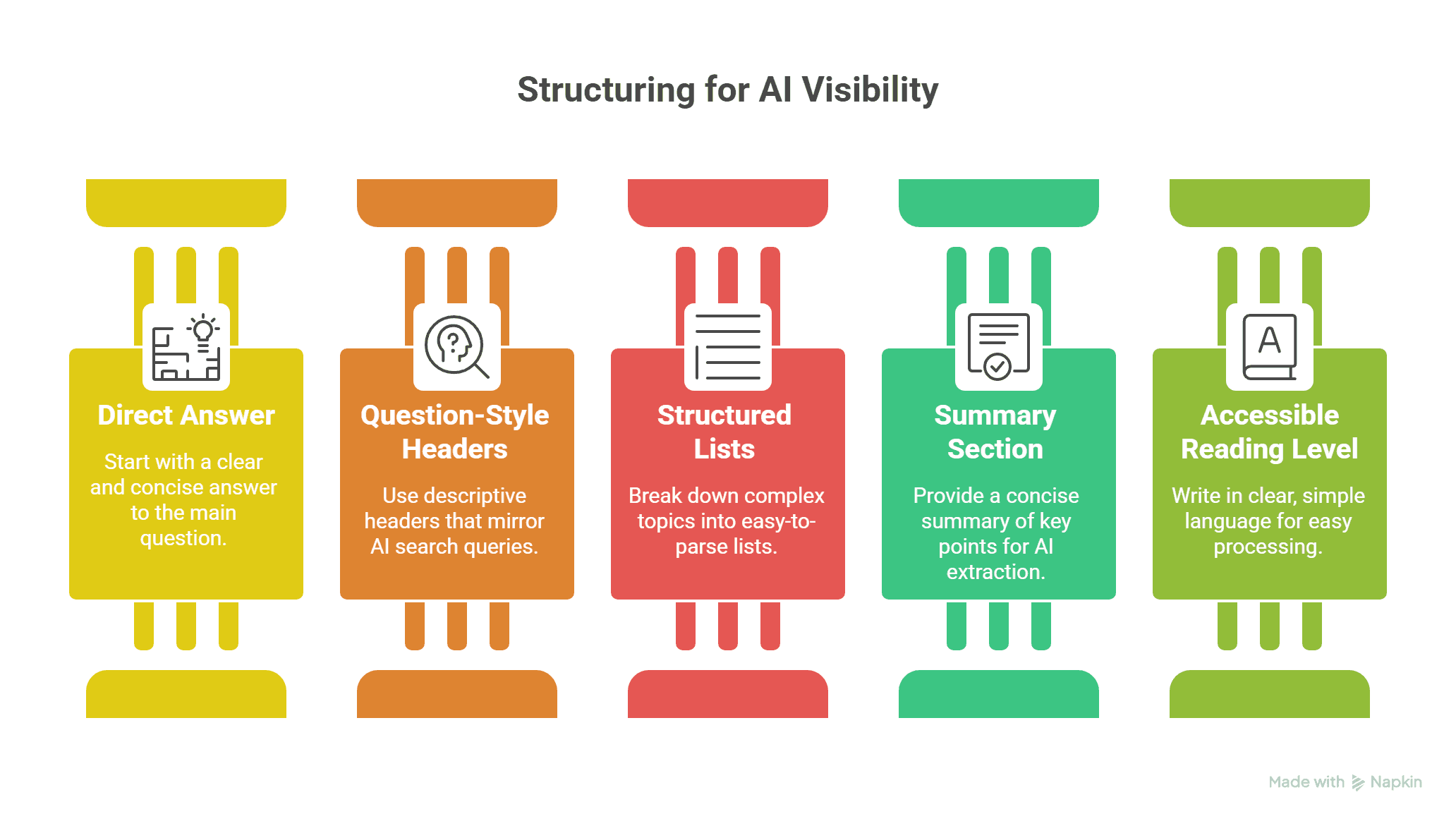
Here is a structure that works well for AI visibility:
1. Start With a Direct Answer
Answer the core question in the first paragraph. Do not make the reader (or the AI) hunt for the point. Lead with the answer, then explain it.
2. Use Descriptive, Question-Style Headers
Instead of a header that says “The Process,” write “What Does the [Your Service] Process Actually Look Like?” Headers phrased as questions mirror the way people query AI tools and make it easier for AI to match your content to relevant searches.
SE Ranking’s 2025 research found that question-based titles carry 7x more impact on AI citations for smaller domains compared to large enterprise sites. This is a huge advantage for small businesses.
3. Break Complex Topics Into Numbered or Bulleted Lists
AI systems love structured lists. If you are explaining a process, a comparison, or a set of options, use a list format. It is easier to parse, easier to extract, and more likely to be cited directly.
4. Include a Summary or Key Takeaways Section
A short summary at the top of a post is incredibly useful for AI systems. It gives them a clean, condensed version of your main points that can be pulled into a generated response without misrepresenting your content.
5. Write at a Reading Level That Is Accessible
This is not about dumbing things down. It is about being clear. Short sentences, plain language, and well-organized paragraphs make your content easier for both humans and AI systems to process accurately.
How Often Should You Publish to Build AI Visibility?
Consistency matters more than volume. One thoughtful, well-structured post per week builds more authority over time than five rushed posts in a sprint followed by months of silence.
The data on content "freshness" is striking. According to BrightEdge, pages updated within the last 60 days are 1.9x more likely to appear in AI-generated answers. Ahrefs’ analysis of 17 million citations across AI platforms found that AI-cited content is 25.7% fresher on average than what appears in traditional Google results. Sites that implement structured data and FAQ blocks see a 44% increase in AI citations (BrightEdge).
That said, quality always beats quantity. A single post that thoroughly answers a question your customers ask regularly is worth more for your AI visibility than a dozen thin posts that barely scratch the surface.
A practical starting point for most business owners is two to four posts per month, each focused on a specific question or topic relevant to your customers. Build that habit for six months and you will start to see your content showing up in places you never expected.
What a Blog Cannot Do on Its Own
It is worth being honest here. A blog is a powerful component of AI visibility strategy... but it works best as part of a broader content ecosystem that include backlinks and directory citations. Paid placement via ChatGPT ads is another layer worth understanding. Here's what small businesses need to know.
Your blog posts should connect to and reinforce your service pages, your FAQ section, and your about page. Internal links between these pages help both traditional search engines and AI systems understand the full scope of what your business does and how credible it is.
Think of it this way: your blog posts attract the AI’s attention by answering specific questions thoroughly. Your service pages and about page then confirm that there is a real, qualified business behind that content. Together, they build a complete picture that AI systems can confidently reference.
And do not overlook schema markup... structured data that helps AI systems understand your content. Sites implementing structured data and FAQ blocks saw a 44% increase in AI search citations, according to BrightEdge. It is one of the highest-impact, lowest-cost improvements you can make.
A Quick Self-Audit: Is Your Current Blog Set Up for AI Visibility?
Before you write another word, it is worth taking ten minutes to assess where you stand. Here are the questions to ask:
Does each post have a clear, question-style heading that matches how your customers actually talk?
Does each post answer its central question within the first two paragraphs?
Are your posts organized with H2 and H3 headers that break the content into scannable sections?
Do your posts link to relevant pages elsewhere on your website?
Have you published anything in the last 90 days?
Are your posts written from genuine expertise, or do they read like content anyone could have written?
Does your blog include an author bio with real credentials?
Is schema markup (like FAQPage or Article) implemented on your blog posts?
If you answered no to three or more of those questions, you have a clear roadmap for where to focus first. You do not need to overhaul everything at once. Start with your most visited existing posts and update them using the structure described above. Then move forward with new posts built the right way from the start.
Frequently Asked Questions
How long does it take for blog posts to start appearing in AI search results?
Most businesses start seeing traction within three to six months of publishing consistently structured, high-quality content. AI systems need time to crawl your content, assess its quality, and build a picture of your topical authority. That said, pages updated within 60 days already perform nearly 2x better in AI answers, so freshness compounds over time.
Do I need to write blog posts myself, or can I use AI to help?
You can absolutely use AI writing tools to help draft, outline, or edit your posts... but the expertise and voice need to be yours. AI-generated content that has not been reviewed, refined, or enriched with genuine firsthand knowledge tends to read as generic, and AI search systems are increasingly good at detecting thin content. Use AI as a productivity tool, not as a replacement for your own insight and experience.
How long should each blog post be for good AI visibility?
For most business-focused topics, 800 to 1,500 words is the sweet spot. Posts should be as long as they need to be to fully answer the question. Padding with filler does not help... AI systems evaluate depth of insight, not word count.
Should I focus my blog on topics my customers search for, or topics within my industry?
Both, but start with your customers. The posts most likely to earn AI citations are the ones that answer questions your actual customers are asking right now. A good mix is roughly 70% customer-question-focused and 30% broader industry insight.
What is the difference between SEO blogging and blogging for AI visibility?
Traditional SEO blogging was often focused on matching exact keyword phrases to rank in a list of blue links. Blogging for AI visibility is focused on thoroughly answering a question in a way that feels credible, structured, and authoritative. The good news is the two approaches are more aligned than ever. Content that genuinely helps a reader will tend to perform well in both. For a full breakdown, see the difference between SEO and AEO.
Does schema markup really matter for AI visibility?
Yes. Sites that implement structured data and FAQ blocks see a 44% increase in AI search citations (BrightEdge), and websites with author schema are 3x more likely to appear in AI answers. Schema helps AI systems understand who wrote your content, what questions it answers, and how credible it is. For small businesses, this is one of the easiest high-impact changes you can make.
* * *
Ready to Put This Into Practice? There Is a Faster Way.
If you are reading this and thinking, “I know I need to do this, but I do not have the time to research keywords, analyze what AI is actually citing, and structure every post from scratch”... you are not alone. That is the reality for most small business owners.
It is exactly why I built the Beacon4ai Content Strategy Tool.
It does the research for you. You enter a topic or question your customers are asking, and it generates a detailed content report... complete with the keywords AI systems are looking for, the competitive landscape, and a structure designed to earn citations. Think of it as the research assistant you wish you had, without the agency price tag.
You bring the expertise. The tool handles the strategy.
Try it free at app.beacon4.ai — your first three reports are on us.