Written by Debbie Anderson, Founder of Beacon4ai | April 27, 2026
If you have been hearing "AEO" more and more lately and wondering how it fits alongside everything you already know about SEO, you are not alone. The difference between SEO and AEO is genuinely confusing at first because both strategies are about search visibility... they just target completely different kinds of search. And with AI-referred website sessions growing 527% year over year, getting clear on that difference is no longer optional for small business owners.
Here is a practical breakdown of what each one does, where they overlap, and how to decide where to focus your energy.
What SEO Actually Does (and What It Does Not)
SEO... search engine optimization... is the practice of making your content easy for search engines like Google and Bing to find, crawl, understand, and rank. The goal is to appear high in the traditional "blue link" results so that people searching for your topic click through to your website.
SEO works by matching your content to keyword-based queries, earning backlinks that signal authority, and building a technically sound site structure that search engine crawlers can navigate efficiently. When done well, SEO drives a consistent stream of organic traffic over time.
What SEO does not do is guarantee your content gets used inside an AI-generated answer. That is a different discipline entirely, and confusing the two is where most people get stuck. Developing a modern content strategy requires understanding both layers.
What AEO Actually Does (and Why It Feels Different)
Answer engine optimization explained simply: AEO is the practice of structuring your content so that AI-powered systems can extract a clear, accurate answer from it and present that answer directly to a user. Think of platforms like ChatGPT, Perplexity, Google's AI Overviews, Gemini, and voice assistants like Siri and Alexa.
The goal of AEO is not a click... it is a citation. When an AI system answers a user's question and attributes that answer to your content, that is AEO working. The user may never visit your website, but your brand becomes the source the AI trusts and references.
Answer engine optimization explained simply: you are writing for machine extraction, not human browsing. That means your content needs to be concise, structured, factually clear, and supported by schema markup so AI systems can verify what you are saying against other sources. To understand how this works in practice, look at how small businesses get found by AI search engines.
You may also see this called GEO... generative engine optimization. The terms are often used interchangeably, and honestly, the industry hasn't fully settled on one. The practical difference: AEO typically refers to optimizing for direct answer extraction in AI interfaces, while GEO is the broader strategy of making your brand a trusted source across all generative systems. At Beacon4ai, we use both terms depending on context. What matters more than the label is the approach: structured content, schema markup, and clear answers that AI systems can find, verify, and cite.
The Core Difference Between SEO and AEO at a Glance
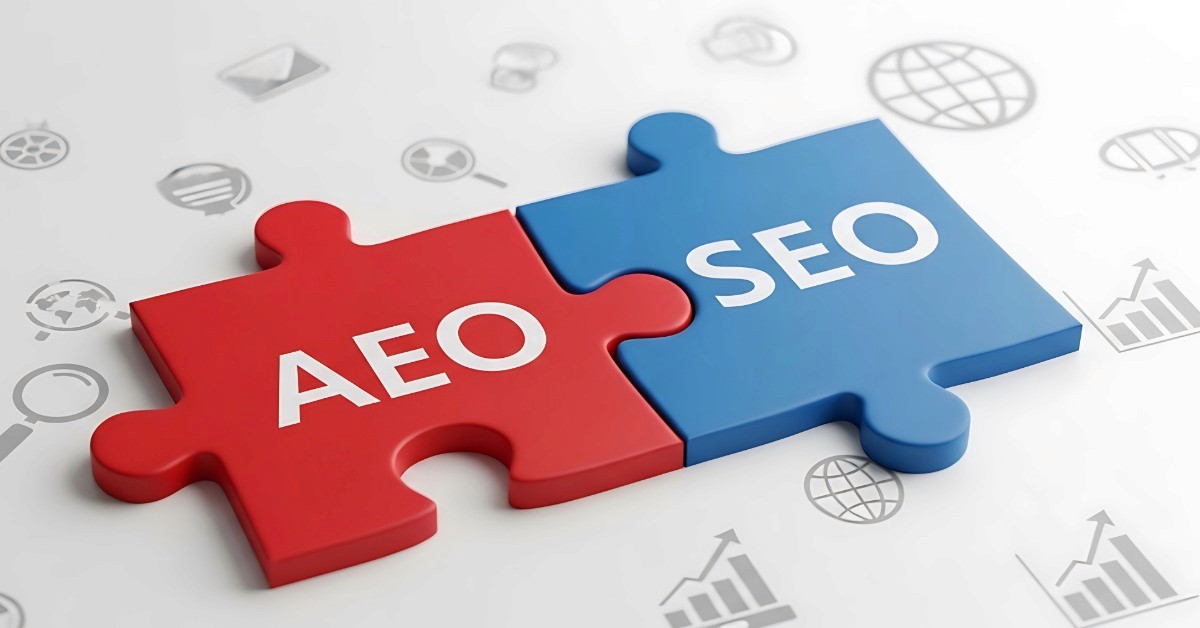
The difference between SEO and AEO comes down to four things: the goal, the audience, the format, and how success is measured.
Factor | SEO | AEO |
|---|---|---|
Primary Goal | Rank high and earn clicks to your site | Be cited inside AI-generated answers |
Target Platform | Google, Bing, traditional search engines | ChatGPT, Perplexity, Gemini, voice assistants |
User Intent | Browsing, researching, comparing options | Getting a quick, direct answer |
Content Format | Long-form articles, detailed guides, blog posts | Concise answer blocks, FAQs, bulleted lists |
Technical Signal | Keywords, backlinks, site authority | Schema markup, structured data, clear Q&A format |
Success Metric | Organic traffic, rankings, click-through rate | AI citations, featured snippet presence, brand mentions |
Click Behavior | User clicks through to your website | User often gets the answer without clicking (zero-click) |
The zero-click reality is worth pausing on. SEO depends on users clicking. AEO often results in the user never visiting your site. That sounds like a loss, but it is not necessarily one. Being the source an AI cites repeatedly builds brand authority in a way that quietly compounds over time.
SEO vs AEO Comparison: How Each Strategy Approaches Content
The SEO vs AEO comparison becomes clearest when you look at how each strategy shapes the way you actually write.
With SEO, you write to rank. You research keywords, build content around them, and structure your pages so that Google can confirm your expertise on a topic. A great SEO article might be 1,500 to 3,000 words, include internal links, and cover a topic from multiple angles to capture a broad range of related searches.
With AEO, you write to answer. Each section of your content should be able to stand alone as a clean, extractable response to a specific question. You write shorter paragraphs, use direct declarative sentences, and format key answers as FAQ blocks or bulleted summaries that an AI system can lift without needing surrounding context.
The interesting thing is that good AEO content is also easier for humans to read. The clarity it demands tends to make everything more useful, which is why the two strategies are more complementary than they first appear.
How AI Search Works (and Why AEO Targets It Differently)
Understanding how AI search works helps explain why AEO requires its own strategy. Traditional search engines like Google rank pages and present a list. Users choose which link to click. The search engine's job ends at the results page.
AI search systems work differently. A platform like Perplexity or ChatGPT reads multiple sources, synthesizes the information, and delivers a single composed answer. It selects which sources to cite based on how clearly and confidently each source states relevant information. Vague or poorly structured content gets passed over even if it technically covers the right topic.
This is why schema markup matters so much in AEO. Schema is code added to your web pages that labels your content in a way machines can read with certainty. An FAQ schema, for example, tells an AI system: "This section contains a question and its direct answer." That label makes your content significantly easier to extract and cite.
AEO for Business Owners: When to Prioritize Each
Most business owners do not need to choose one or abandon the other... but you do need to know where to start. Here is a simple framework based on where you are today.
Start with SEO fundamentals if:
Your website is new or has little to no organic traffic
You have not yet built a library of quality content
Your business relies on people clicking through to browse your services, read case studies, or contact you
You are in a local market where Google Maps and organic rankings drive most of your leads
Layer in AEO tactics if:
You have existing content that already ranks reasonably well
Your business answers a lot of "how," "what," and "why" questions from customers
You want to appear in AI-generated answers when people ask questions in your industry
You serve customers who use voice search or AI assistants to find information
The bottom line: AEO rewards content that is already trusted. If your SEO foundation is thin, AI systems have no reason to cite you. Build the foundation first, then optimize for extraction.
Content Optimization for AI: What to Actually Change in Your Writing
Content optimization for AI is less about adding new pages and more about reformatting what you already have. Here is what makes the biggest practical difference.
Lead every section with the answer. Do not build up to your point... state it in the first sentence. AI systems parse the opening of each section first and may not reach a conclusion buried at the end of a long paragraph.
Use direct, factual sentences. Avoid hedging language like "it could be argued that" or "some people believe." AI citation systems favor confident, specific statements that can be verified.
Add FAQ blocks. A clearly formatted question followed by a 2-4 sentence answer is one of the most commonly extracted content formats. If you have pages that answer common customer questions, restructure them with explicit Q&A formatting.
Implement schema markup. At minimum, add Article schema to your blog posts and FAQPage schema to any page with question-and-answer content. This makes your content machine-readable in a way that gives AI systems confidence to cite it.
Keep your information accurate and current. AI systems cross-reference sources. If your content contradicts other reliable sources, it is less likely to be cited... and more likely to damage your credibility.
SEO and AEO Together: The Compounding Advantage
Running SEO and AEO together is where the real long-term advantage lives. These are not competing strategies... they are two layers of a modern visibility system.
SEO builds the authority that AEO leverages. A page that ranks well on Google is more likely to be crawled and indexed by AI systems. A brand that earns consistent organic traffic signals credibility that AI models factor into their source selection. Good SEO makes your AEO more effective.
AEO, in turn, reinforces your SEO. Content written for extraction tends to be clearer, better structured, and more directly useful... all of which improve user engagement signals that search engines factor into rankings. Zero-click citations also drive brand awareness that eventually converts to branded searches, which Google reads as a strong authority signal.
The zero-click search strategy that AEO enables is not a traffic-killer... it is a brand-builder. The business owners who treat these strategies as a unified system rather than separate tactics are the ones building durable AI visibility as search continues to evolve.
Frequently Asked Questions
Are SEO and AEO the same thing?
No. SEO and AEO share some overlapping practices but have fundamentally different goals. SEO optimizes content to rank in traditional search results and drive clicks to your website. AEO optimizes content to be cited inside AI-generated answers, often without the user ever visiting your site. You need both, but they require different content structures and different success metrics.
Does AEO replace SEO?
AEO does not replace SEO... it adds a layer on top of it. Your existing SEO foundation, including your domain authority, backlinks, and indexed content, is actually what makes AEO more effective. AI systems are more likely to cite content from sources they can already verify as credible. If your SEO is weak, your AEO will struggle too.
What kind of content works best for AEO?
Content that works best for AEO is concise, structured, and written in a direct question-and-answer format. FAQ sections, bulleted summaries, definition blocks, and short explanatory paragraphs all perform well. Schema markup... particularly FAQPage and Article schema... signals to AI systems that your content is structured for extraction, which increases citation likelihood.
How do I know if my content is being cited by AI search systems?
You can test this manually by asking questions related to your content in platforms like ChatGPT, Perplexity, or Google's AI Overviews and seeing whether your domain is mentioned or linked. Some third-party tools are also emerging that track AI citation visibility, though this space is evolving quickly. Monitoring your branded search volume over time can also signal whether AI visibility is driving awareness.
Should a small business focus on AEO or traditional SEO first?
For most small businesses, traditional SEO should come first. Building a foundation of well-structured, keyword-informed content that earns organic traffic creates the credibility AI systems use when selecting sources to cite. Once you have that foundation, reformatting key pages with AEO best practices... clear answer blocks, FAQ schema, and direct declarative writing... is a relatively low-effort layer that can significantly expand your search presence.
________________
Customers ask AI for recommendations. Is AI recommending you... or your competitors?
The Content Strategy Tool® does 85% of the work in 120 seconds... AI-optimized article, schema, FAQs, and social posts from one report. Try 3 free reports → No credit card. No sales call.