
Written by Debbie Anderson, Founder of Beacon4ai | June 16, 2026
If you read the query fan-out section in the last issue of Found., this is the big-brother version... the same idea, taken all the way down to what you actually do about it on your website this week.
Here's the short version, in case you missed it. When someone asks an AI assistant a question, it rarely runs just that one search. Behind the scenes, it "fans out" the question into a whole bundle of related sub-questions, searches all of them at once, and stitches the best pieces together into a single answer. That quiet little move changes how you should write every page on your site. And the good news is that once you see the pattern, it's not complicated. It's actually kind of freeing.
Let's get into it.

What Is Query Fan-Out, Exactly?
Query fan-out is the process where an AI search system takes one question and turns it into many specific sub-questions, then pulls answers from across the web to build one complete response. Instead of matching your keywords to a page the way old-school Google did, the AI is running a tiny research project every single time someone asks it something.
The term actually comes from Google. When it launched AI Mode, Liz Reid, Google's Head of Search, described the technique as breaking your question into subtopics and firing off a multitude of searches simultaneously on your behalf. So this isn't a fringe SEO theory... it's how the biggest search engine in the world now openly says it works.
Picture our bakery from the newsletter. Someone asks, "who's the best bakery in town for a wedding cake?" The AI doesn't just go looking for that exact phrase. It quietly fires off a cluster of related searches... bakeries near me, wedding cake specialists, custom cake reviews, pricing, lead times, tasting appointments... and then assembles the answer from whatever it finds for each one.
I like to think of it as a tree. The original question is the trunk. Every sub-question is a branch. And the specific paragraphs the AI lifts from web pages are the leaves. Your whole goal is to make sure your content is growing leaves on as many of those branches as possible.
That's the part most businesses miss. A page that only answers the trunk question and ignores all the branches is invisible to most of the fan-out. But a single page that answers several of those sub-questions well starts to look like a reliable source to the AI... and that's what earns you the mention.
If you want the foundation underneath all of this, my earlier piece on Understanding AI Search Behavior walks through those "hidden searches" AI runs before it ever shows an answer. Fan-out is what that looks like in motion.
How AI Search Actually Runs a Fan-Out
The exact mechanics shift a little from platform to platform, but the pattern holds across Google AI Mode, ChatGPT, Perplexity, and Gemini. It goes something like this.
First, the AI takes your question apart. It figures out what you're literally asking, what you probably need to know but didn't say, and what you'll most likely wonder about next. This isn't keyword matching. It's the AI reasoning about your actual intent.
Then it generates the sub-queries... comparisons, related topics, how-to versions, and angles specific to your situation. For an everyday question, that's usually somewhere around eight to twelve sub-queries. A deep-research style question (the kind you'd ask in Perplexity's research mode or ChatGPT's deep research) can spin up dozens, sometimes hundreds. Same idea either way.
Next comes the part almost nobody writes about: the AI pulls passages, not whole pages. It is not reading your entire article and grading it. It is reaching in and grabbing the specific chunk of text that answers each sub-question. That means one clear, self-contained paragraph has just as good a shot at getting picked as a 5,000-word guide that buries the same answer halfway down. And here's the stat that should change how you think about this: research reported by Search Engine Land found that roughly 68% of pages cited in AI answers were not ranking in the top ten organic results, for either the main question or any of its sub-queries. Being number one on Google is no longer the price of admission.
Finally, the AI assembles those passages into one answer and credits the sources it pulled from. That credit, that little citation, is how your business shows up.

Why This Matters for Your Business
You're not trying to win one keyword anymore. You're trying to be a good answer to a whole cluster of related questions. The businesses that show up in AI answers are the ones whose content covers the natural follow-ups, not just the headline search.
That single shift is the whole game. It moves you away from chasing one phrase and toward genuinely covering a topic the way a real customer thinks about it... messy, branching, full of "but what about" questions.
And here's the part I love, because you may already be doing it without realizing.
The Pillar-and-Cluster Method Is Query Fan-Out, Published
If you've ever built a pillar page with a set of supporting articles around it, you've already built the published version of a fan-out tree. Think about it. A pillar answers the big main question. Each cluster article answers one of the natural follow-ups. And they're all linked together so the connections are obvious.
That is exactly how the AI takes a question apart... main question, then all the branches, all related. When you build content as a connected pillar and cluster, you're not guessing at what the AI wants. You're handing it a topic that's already organized the way it thinks. And the more completely you cover a subject across those connected pages, the more the AI starts treating you as an authority on it. That topical authority is what earns the citation, over and over.
This is the difference between scattered one-off blog posts and a content system. If you want to see how the linking piece works, I get into it in Internal Linking Strategy... the content cluster model is the engine that makes this whole thing run.
So when people ask me whether they need some brand-new strategy for AI search, my honest answer is usually no. You need to do the good, thorough, connected content work you've been hearing about for years... just with fresh eyes on why it matters now.
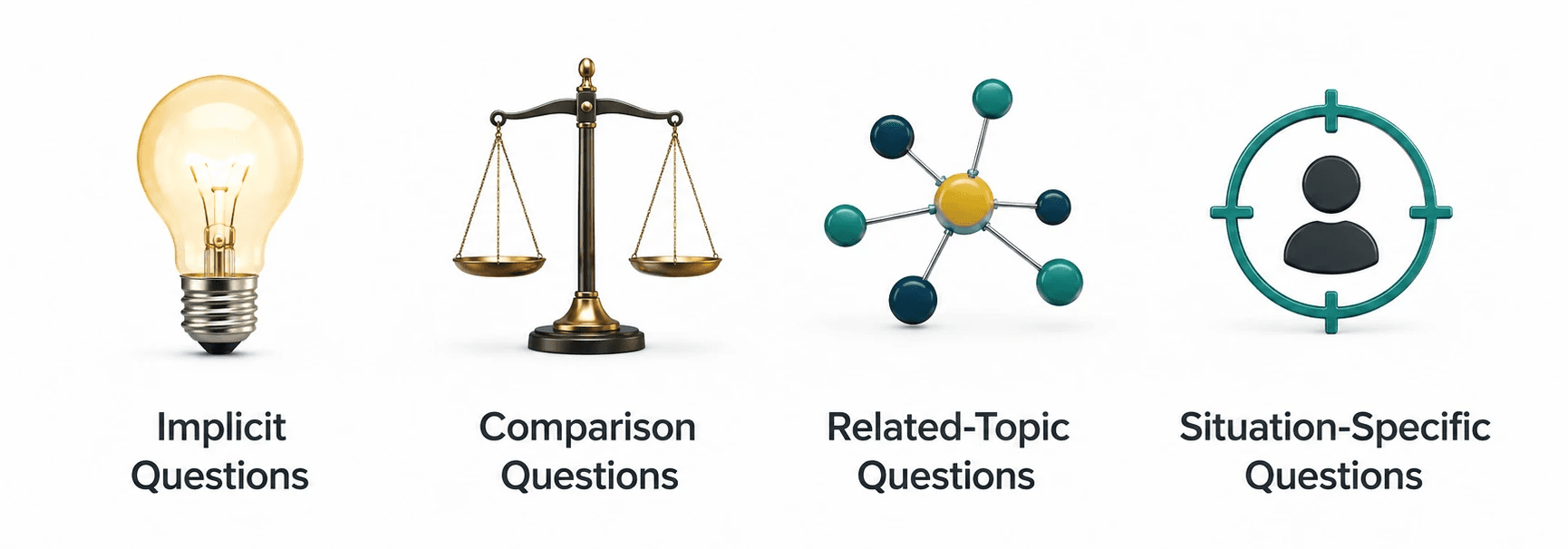
The Four Kinds of Sub-Questions AI Generates
Once you know the categories of sub-questions AI tends to create, you basically have a content checklist. Here are the four worth knowing.
Implicit questions are the things your customer needs but didn't actually ask. The background, the definitions, the "wait, what does that even mean" pieces.
Comparison questions are the this-versus-that moments. Option A or Option B. The pros, the cons, the trade-offs.
Related-topic questions branch out to the connected tools, terms, and concepts that naturally come up alongside the main one.
Situation-specific questions are the ones tailored to a particular kind of customer... their industry, their budget, their town.
Most business content only ever handles the first one, maybe touches the third, and completely skips comparisons and situation-specific angles. Which is great news for you, because those last two are where the easiest wins are hiding. Almost nobody is writing them.
Back to the bakery. A page about wedding cakes will get fanned out into branches like "how far in advance to order a wedding cake," "wedding cake vs. dessert table cost," and "gluten-free wedding cake options near me." If your page only explains that yes, you make wedding cakes, you've answered one branch and missed the rest of the tree.
How to Map Your Own Fan-Out (Before You Write a Word)
This is the part the SEO blogs love to mention and never actually show you. Here's how to build a fan-out map for any topic, start to finish.
Begin with your trunk question. That's the main thing your ideal customer is asking, written exactly the way they'd say it out loud to an AI assistant.
Then ask yourself five honest follow-up questions. What would they need to know before they could act on your answer? What would they wonder about right after reading it? What would they naturally compare you to? And what version of this question is specific to their situation... their budget, their timeline, their neighborhood?
Next, go peek at Google's autosuggest and the "People Also Ask" box. When you start typing your trunk question into Google, those suggestions that pop up are a direct preview of the fan-out tree. AI systems lean on very similar patterns, so this is basically a free window into the branches you need to cover.
Now write your list. Aim for eight to twelve sub-questions. Each one becomes a section heading on your page, and each should be answerable in two to four tight paragraphs.
Finally, look for the gaps. Which of those sub-questions can't you answer with real authority yet? Those gaps are your homework... either something to research before you write, or a sign that this particular topic isn't quite in your wheelhouse yet. Both are useful to know.
If you'd rather not map all of this by hand, this is the exact step the Content Strategy Tool was built to do for you. It pulls the real questions your customers are typing... live from Google's Related Searches, People Also Ask, and Autocomplete... which is the same source material AI systems are trained on and looking for. So instead of guessing at the branches, you're handed the actual fan-out tree for your topic. (Full disclosure, that's our tool. I built it because I got tired of doing this step by hand for every single client.)
How to Write So AI Can Actually Lift Your Answer
Having the map is half of it. How you write each section decides whether the AI can cleanly pull your passage and use it. A few habits make all the difference.
Lead every section with the answer. Not a windup, not context, the actual answer in the first sentence. If your heading is "how far in advance should I order a wedding cake," your opening line should be something like "Most bakeries recommend ordering your wedding cake six to twelve weeks ahead, and longer during wedding season." Say the thing first. Explain after.
Write paragraphs that can stand on their own two feet. The AI yanks passages out of context, so if your paragraph only makes sense after someone's read the three before it, it's hard to use. Keep your "this" and "it" and "that approach" specific. Name things plainly.
Turn your sub-questions into your headings. A heading that's phrased like the actual question tells the AI precisely what the passage underneath answers. It's the difference between a clearly labeled drawer and a junk drawer.
Don't bury your best answer in paragraph seven. If the most useful, most specific thing you have to say is way down the section, the AI may never reach it cleanly. Put your strongest stuff up top, in every section.
None of this is fancy. It's just clear, organized, answer-first writing... the kind that happens to be good for the humans reading it too.
Quick Word on ChatGPT vs. Perplexity vs. Google AI Mode
People always ask whether they need to write differently for each platform, and the honest answer is: less than you'd think. Google AI Mode tends to fan out harder on complex questions, and traditional signals like being properly indexed still matter there. Perplexity leans on real-time retrieval and rewards content that makes clear, specific claims instead of hedging everything. ChatGPT's deep-research mode is the most aggressive fan-out of the bunch, and it loves a single page that covers a topic thoroughly so it doesn't have to stitch together five sources.
But the thread running through all three is the same: clear, specific, well-structured, answer-first content wins. You're not writing three different versions. You're writing one good one.
The Mistakes Worth Fixing First
A few habits quietly sabotage your fan-out coverage. These are the ones I'd fix before anything else.
Writing for the trunk only. Most business pages answer the headline topic and stop cold. Add the comparisons, the how-tos, the "for my situation" angles, and the common-mistake sections. That's where the extra branches live.
Leaning on vague, in-context language. Phrases like "as mentioned above" or "this approach we talked about" are useless to an AI grabbing a single passage mid-article. Be explicit every time. Name the thing, state the claim.
Treating every sub-question the same way. A "what is" question needs a crisp definition. A comparison needs a real breakdown. A how-to needs actual steps. Match the format to the kind of question you're answering.
Publishing and forgetting. AI systems re-check content over time, and a page that gets cited today can quietly fall out of the rotation when something fresher shows up. Revisiting your fan-out map every six to twelve months and refreshing the stale sections keeps you in the running.
Yup, This Is a Lot of Work
Let me be straight with you, because I think you can probably feel it already. Everything I just walked you through... mapping the trunk and all its branches, writing eight to twelve sections that each open with a clean answer, building out the FAQ, structuring schema so AI can actually read it, then connecting it all into a pillar and cluster... that's real work. For one topic. Done well, it's the better part of a day. And most small business owners do not have a spare day every week to do this for topic after topic after topic.
That is the whole reason I built the Content Strategy Tool. I watched this exact to-do list bury good business owners who simply did not have the hours. So I made the thing I wished existed. You type in one question... your trunk query... and in about two minutes it hands you back the fan-out already mapped (pulled live from Google's real People Also Ask and Autocomplete data, which is the same material AI is trained on), a complete article that's about 85% written and structured the way AI prefers to cite, five strategic FAQs, ready-to-paste schema code, an internal linking map with those [LINK TO:] markers showing exactly where to connect things, and a five-topic content cluster roadmap so you already know what to write next.
Look back at everything in this article. The mapping. The passage-level writing. The FAQ. The schema. The cluster. Every one of those sections is a thing the tool does for you, from a single query, in the time it takes to refill your coffee.
What it does not do... and never will... is the 15% that's actually you. Your real examples, your local knowledge, your voice, the wedding-cake story only your bakery can tell. That part AI can't replicate, and honestly it shouldn't. The tool clears away the research and the structure so your time goes to the one thing that was always yours to begin with.
You can absolutely do all of this by hand. Plenty of people do, and this whole guide is here so you can. But if reading it made you quietly think "wow, that is a lot"... that feeling right there is exactly who I made the tool for.
Frequently Asked Questions
Is query fan-out the same as what an AI does when it searches the web?
Not quite. Fan-out specifically means expanding one question into many parallel sub-questions to build a complete answer. When an AI does a quick single search to check one fact, that's just basic grounding, not a full fan-out. Real fan-out shows up in deep-research modes and bigger, multi-part questions where the AI needs to explore a topic from several angles at once.
How many sub-questions does one search usually create?
It ranges. Independent analyses of AI search behavior put it at roughly eight to twelve for an everyday question, climbing to dozens or even hundreds for a deep-research prompt. It depends on the platform, how complicated the question is, and how confident the AI already feels... simple factual lookups ("capital of Spain") barely fan out at all, while decision-heavy questions with words like "best," "top," or "vs" trigger the most. For planning your own content, mapping eight to twelve sub-questions per topic is a solid working target.
Do I need a separate page for every sub-question?
No, and trying to would actually backfire. The goal is for one well-built page to answer several sub-questions from a single URL. That's what signals authority... the same trusted source covering multiple branches. Only spin off a separate page when a sub-topic is genuinely big and distinct enough to deserve its own.
How is this different from regular keyword research?
Traditional keyword research finds the phrases people type and helps you rank for them. Fan-out mapping asks a different question entirely: given what this person is actually trying to accomplish, what's everything they need answered along the way? You'll end up covering a lot of the same terms, but you'll organize your content around real intent instead of single keywords... and that structure is what AI rewards.
How long until a fan-out-optimized page starts earning citations?
There's no guaranteed timeline, and it varies with how competitive your topic is and how well-covered it already is. Indexing usually happens within days to a couple of weeks. Whether you actually get cited depends on how your content holds up against what's already out there. Give it a 60 to 90 day window after publishing before you judge how it's doing.
_____________________
Everything in this guide, done for you from a single question in about two minutes... the fan-out map, the 85%-written article, the FAQs, the schema, the cluster roadmap. The Content Strategy Tool handles the research and structure, so you only have to add the part that was always yours: your voice and your expertise. Try it free... three reports, no credit card, no sales call. Just proof it works.
Related in this Topic

How to Optimize Your Blog Posts for AI Search Visibility: Getting Featured in Google AI Overviews, ChatGPT, and Perplexity

Internal Linking Strategy

Understanding AI Search Behavior

SEO vs AEO: What They Are, How They Differ, and Which One Your Content Actually Needs

The 15 AI Visibility Metrics Explained